By Patience Moseley, Ph.D.
FSU College of Medicine
Xiaofei Jia, Ph.D., associate professor in the Department of Biomedical Sciences, received a $3.8 million grant from the National Institute of Allergy and Infectious Diseases to study how to prevent HIV from evading the body’s immune system.
HIV infects human immune cells. If untreated, it will damage the immune system, leading to AIDS.
Current antiretrovirals stop viral replication and prevent the onset of AIDS, but the viral infection remains present, requiring patients to remain on antiretrovirals for life. Discontinuing them can lead to the rapid return of HIV within a few weeks.
Applying his expertise in HIV research, Jia aims to address the viral reservoir and how it evades immune detection with the hope that a treatment strategy will one day be able to eradicate HIV from the body.
“What's unique about HIV is that it integrates its own genome into the host cell's genome,” Jia said. “This is a big part of why getting rid of the infection is so difficult.”
Curing HIV would require immune cells to find HIV-infected cells and kill them. However, HIV has acquired the ability to put on an “invisibility cloak” – a viral protein called Negative Factor (Nef) – enables infected cells to evade detection by immune cells. This is driven by Nef lowering the expression of two host proteins, MHC-I and CD4, on the cell’s surface.
“Infection is detected when the proteins of the pathogen are produced in the cell and the immune system displays these protein fragments on the surface,” Jia said. “With these fragments presented in this manner, the immune system can then recognize that there is something foreign and that the cell is infected. MHC-I plays an essential role in this process. And preventing MHC-I from doing its job here is one way HIV hides itself from the immune system.
“These invisibility tricks are another reason why HIV infection is so hard to cure.”
Patients with HIV-1 infected cells lacking functional Nef do not develop AIDS. Instead, the infected cells should continue to express MHC-I and CD4, allowing the immune system to effectively identify and destroy them. Naturally, the viral concentrations remain low, delaying disease progression for decades, even without medication.
With this grant, Jia plans to screen and identify molecules that inhibit Nef’s functions. Identifying and characterizing the most potent Nef inhibitors provide hope and progress toward more specific, perhaps more effective, antiretroviral treatments for HIV patients.
“Nef is one protein with many jobs, and almost all of them are for evading the immune system,” Jia said. “If you look at the structure of how this is accomplished, it's really very fascinating. Every time I think, ‘it's a small protein, it has limited ability,’ I am always surprised how things are made to happen.”
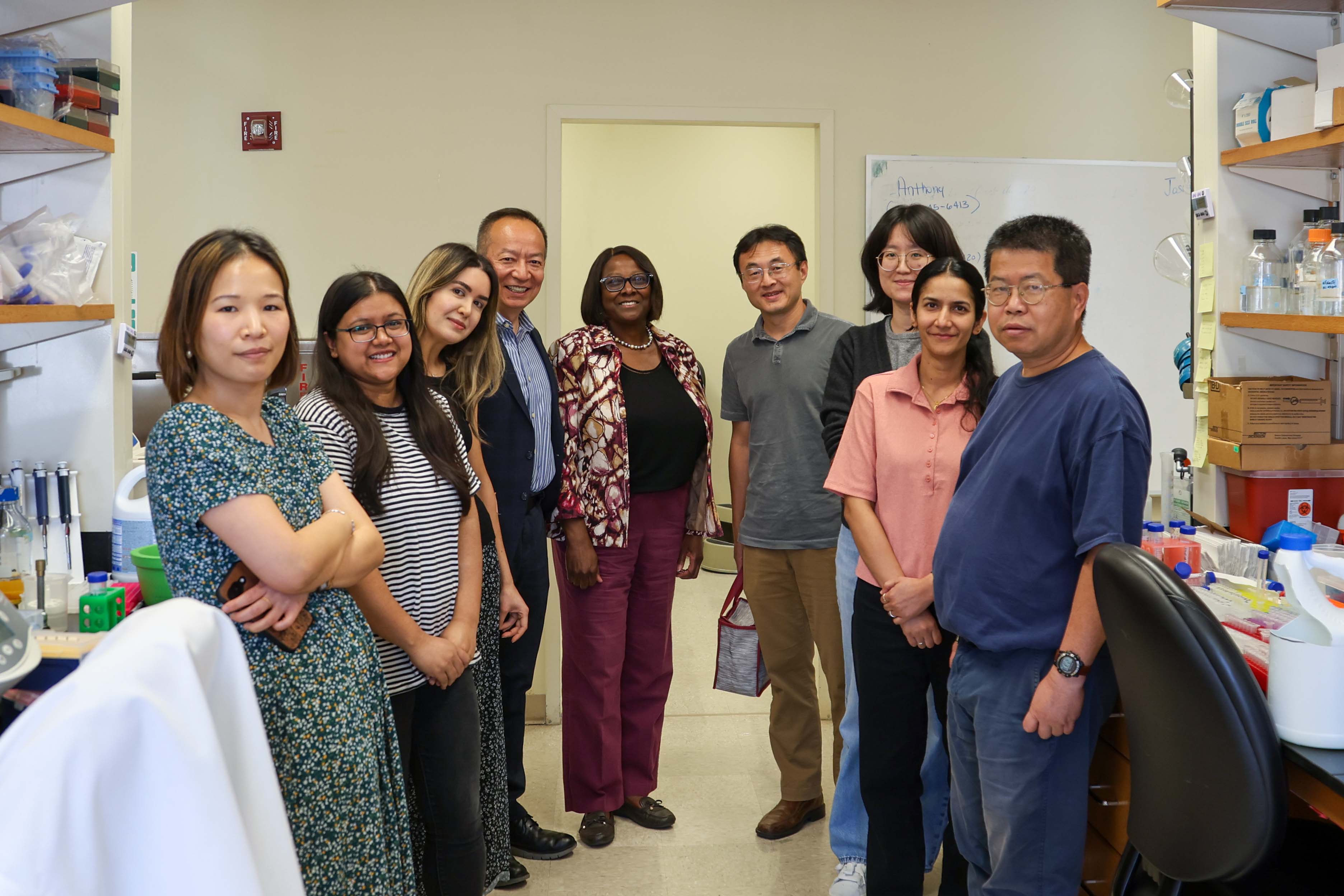
Jia has spent his academic career studying HIV. Since joining the FSU College of Medicine in January 2025, Jia has built a team of researchers who share a similar interest.
“Dr. Jia’s cutting-edge research to unravel the precise cellular mechanisms is not only important for understanding how this virus evades the human immune system, but it also directly advances the FSU College of Medicine’s mission to drive transformative scientific discovery that transforms human health,” said Cathy Levenson, interim chair of Biomedical Sciences.
Jia’s extensive background in HIV research, along with this funding support from a division of the National Institutes of Health, positions him to tackle the virus’s complex structural biology, bringing medicine one step closer to a cure.