By Audrey Post
FSU College of Medicine
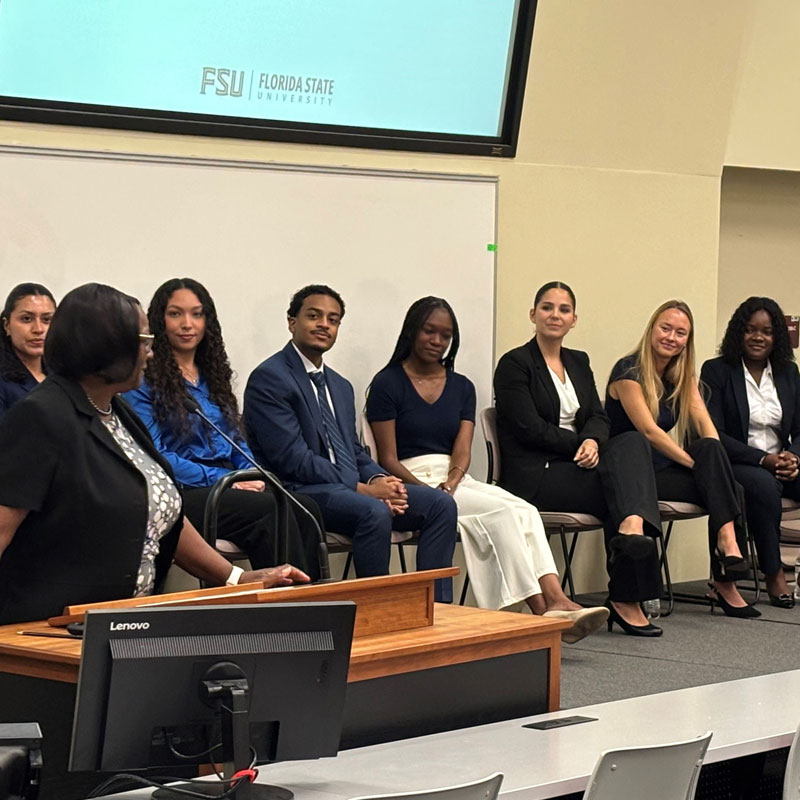
Just days before the seven students in the Florida State University College of Medicine’s Bridge to Clinical Medicine program graduated with their master’s degrees in biomedical sciences, they presented the results of their capstone research projects.
The 17th annual showcase combined the final requirement of the intensive yearlong program with a graduation reception and a celebratory brunch acknowledging their hard work — a perfect sendoff as the students enter medical school exactly two weeks later as part of the M.D. Class of 2030.
After welcoming students, faculty and staff to the event, Elizabeth Foster, Ph.D., associate dean for Interdisciplinary Medical Sciences and research director of the Bridge program, introduced the faculty mentors who worked with the students. She noted that several had been volunteering as mentors for many years, including Antonio Terracciano, Ph.D., of the Department of Geriatrics and Karen Geletko, MPH, of the FSU Area Health Education Center, part of the Department of Behavioral Sciences and Social Medicine (BSSM).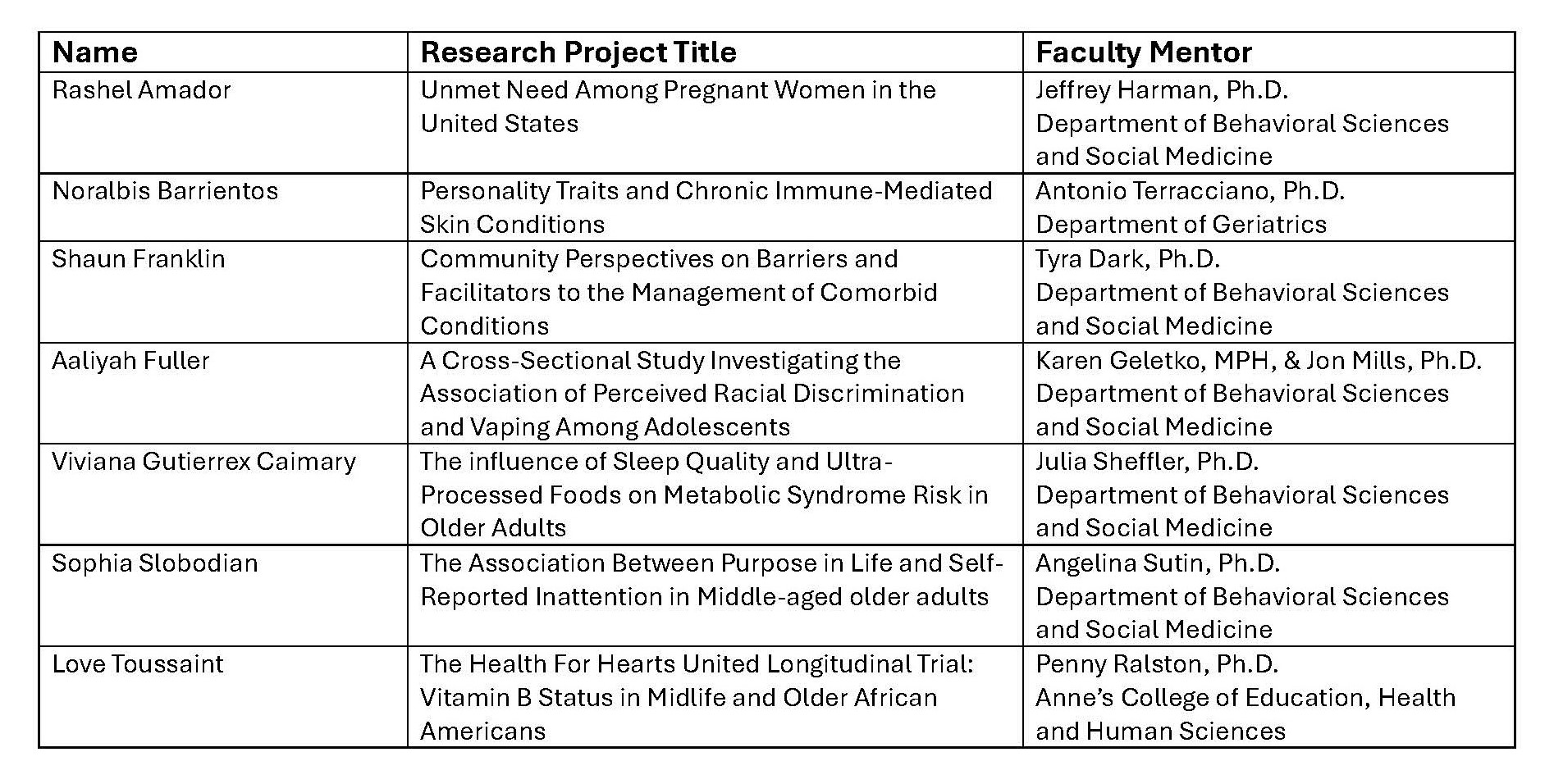
“I began mentoring Bridge students in 2013 because I admire the program’s mission to expand the future of healthcare. Thirteen years later, it remains one of the most rewarding parts of my job.” Terracciano said.
“These students bring novel perspectives to scientific questions. Seeing their hard work culminate in research presentations and scientific publications is incredibly gratifying.”
This was Geletko’s 10th year serving as a mentor, which gives her, as research faculty, an opportunity to still play a meaningful role in students’ education, she said. She and colleague Jon Mills, Ph.D., also research faculty in BSSM, worked as partner-mentors.
“I get to share my enthusiasm for research, and it’s incredibly rewarding to see them develop an appreciation for it,” Geletko said. “What makes this experience unique is that these students engage in research and make real contributions to the field before they even begin medical school, which isn’t always part of the traditional path.
“The Bridge students are consistently such an impressive group, and working with them leaves me optimistic about the future.”
Anthony Speights, M.D., senior associate dean for medical education and academic affairs, got a little emotional as he congratulated the students.
“Some of you know that I have taken on a new role and this is my last research presentation as director of the Bridge program,” he said. “It has truly been my honor to help guide you on this portion of your medical education journey. I am so proud of each and every one of you, and I know you’re all going to do great things.”
Speights spent 10 years with Bridge, the first two as clinical faculty advisor and the past eight as director.
[Link: As 2026 M.D. commencement speaker, Speights talks straight to the graduates.]
Robert Campbell, M.D., associate dean for student affairs and admissions, echoed Speights’ sentiment, reminding the students that as Bridge graduates, they have knowledge of the College of Medicine and how it operates that their non-Bridge classmates do not.
“You will be looked at as class leaders by your classmates … you will often become the go-to person for advice and teaching, even though these students will have access to TAs (teaching assistants) … your advice on how to survive and thrive will be sought,” he said.
He challenged them to accept the Bridge leadership legacy as they begin medical school.
“Share your knowledge and advice. Calm the class when you can with your experience. … We are proud of you, and we are looking forward to the next step of your journey and the next mountain you will climb to become a great doctor,” Campbell concluded. “See you back here in two weeks.”
Alma Littles, M.D., dean of the College of Medicine, also added her congratulations. Nodding in Campbell’s direction, she said, “Rob, you’re getting a good group.”
Research topics ran the gamut of the healthcare spectrum and included unmet needs among pregnant women in the United States; the association between perceived racial discrimination and vaping among adolescents; and how sleep quality and consuming ultra-processed foods influence metabolic syndrome risk in older adults. (A complete list of students, topics and mentors can be found at the end of this article.)
Aaliyah Fuller, class liaison officer, fought to stay composed during her remarks as she thanked Foster, Speights and Linda Netherton, Bridge program manager who is moving to the dean’s suite as Speights’ executive assistant.
“To Mrs. Netherton, you are truly the glue that holds us all together. Thank you for being our biggest supporter,” Fuller said. “What you do for us behind the scenes does not go unnoticed, and we are grateful for the time and attention you pour into us as students.”
Fuller’s final remarks, however, were directed at her Bridge classmates.
“We did it! From late nights in the lab, stimulating discussions on ethics, and countless hours on our research projects, we made it,” she said. “I am very proud of how far each of us has come.”