

First-, fourth-year M.D. students share White Coat, GHHS Induction stage
By Audrey Post
FSU College of Medicine
The select group of fourth-year medical students took to the stage, standing alongside faculty members as their first-year counterparts filed into Ruby Diamond Concert Hall and were directed to their seats, front and center. Family and friends cheered, waved and hollered as they recognized “their student.”
The first-year students, called “M1’s” in academic vernacular, each had a freshly pressed white coat draped over an arm. Seeing their names embroidered on their jackets had made it real, but the Aug. 7 M.D. Class of 2030 White Coat Ceremony was about to make it official: They had completed their first semester of medical school and were about to be “coated,” officially welcomed to the profession of medicine.
As College of Medicine Dean Alma B. Littles, M.D., explained to the audience in her welcoming remarks, it was no accident the contingent of fourth-year students was waiting on stage. The 13 “M4’s” had been selected for membership in the FSU Chapman Chapter of the Gold Humanism Honor Society (GHHS), along with five other members of the M.D. Class of 2027 who could not attend Friday’s ceremony. Membership is limited to 10-15% of each M.D. class.
"They were nominated by their peers and faculty and were chosen based on qualities demonstrating their embodiment of the service calling of medicine," Littles said "We hold these inductees up to you, first-year medical students, as an example of what we hope you will strive for."
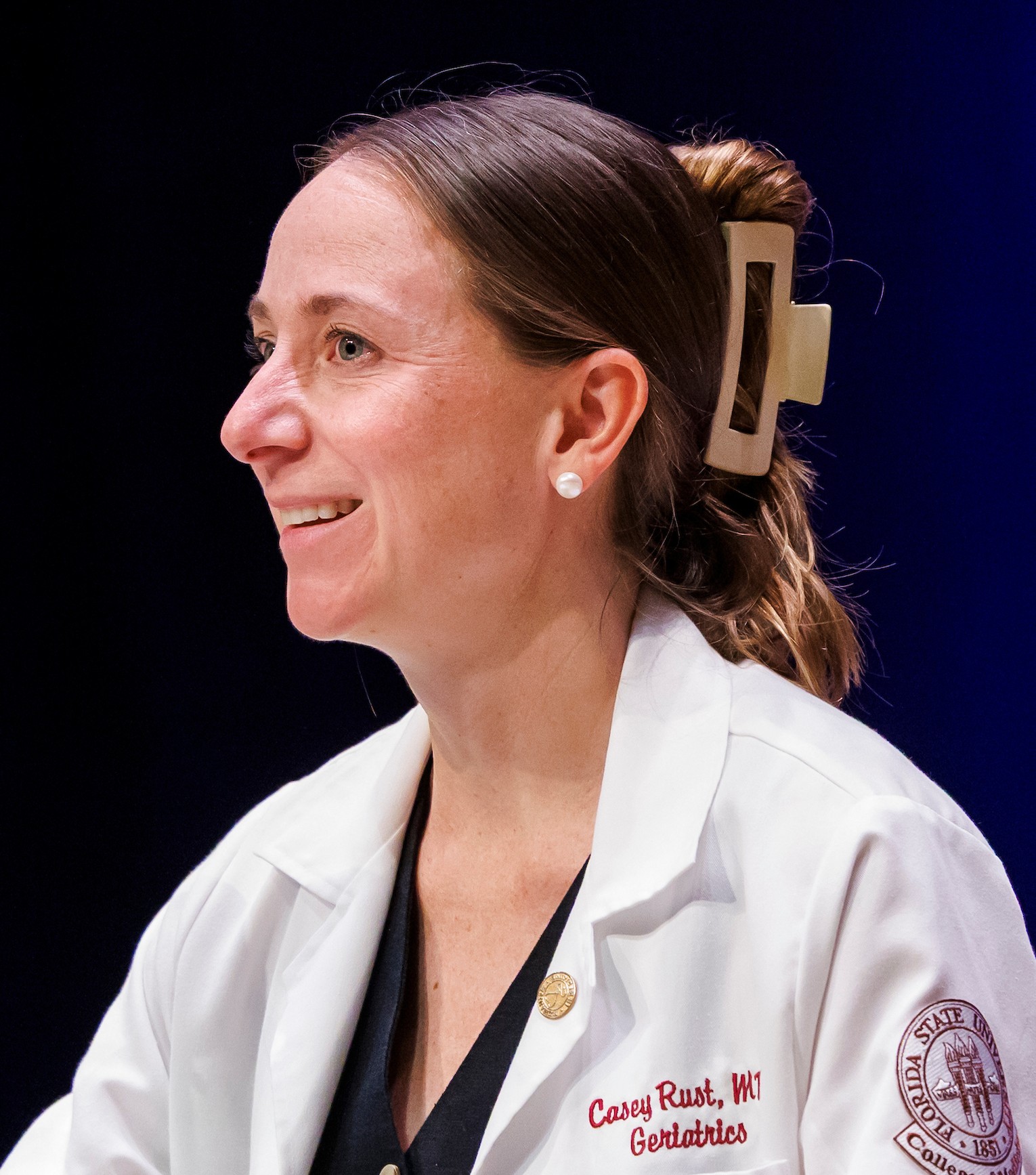
Casey Rust, M.D., an assistant professor in the Department of Geriatrics – and soon to be an associate professor, as Littles noted in her introduction – is GHHS co-advisor. She shared that the Arnold P. Gold Foundation has helped establish White Coat Ceremonies in 95% of medical schools in the United States. The FSU Chapman Chapter of GHHS pays for the M.D. students’ first white coats.
“Most medical schools in the country have now adopted the concept of teaching patient-centered medicine – not disease-centered and not doctor-centered – but truly focused on serving the unique needs of the patient,” said Rust, an M.D. Class of 2016 alumna. “Humanism takes it even further. Humanism includes attributes such as compassion, service, integrity and respect.”
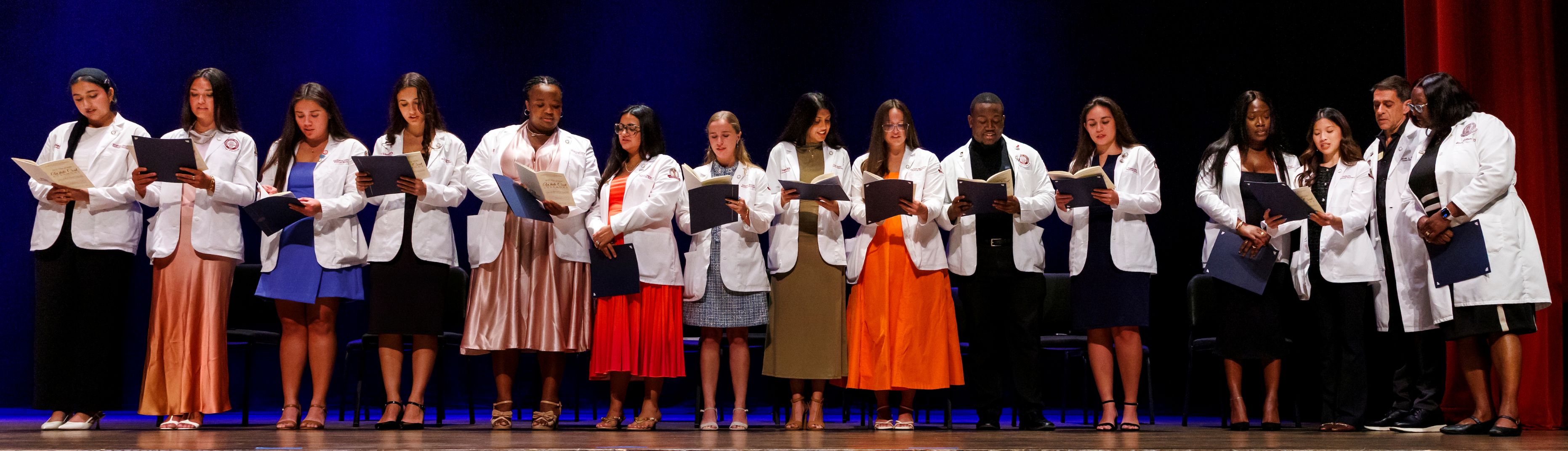
After each new member was pinned and all recited the society’s oath, Holly Vu addressed the gathering on behalf of the M.D. Class of 2027 and the other GHHS inductees. She reminded students that while their white coats will grant them entry into patients’ rooms and most vulnerable moments, it will be their character that gains patients’ trust.
“It’s sitting down at eye level instead of standing during a difficult conversation … it’s warming your hands before a physical exam because a patient once jumped and said, ‘Oh! Your hands are cold!’
“It’s learning the names of the nurses, our front desk staff, and janitorial services,” Vu continued. “It’s choosing curiosity over judgment when somebody’s choices or values differ from your own.
“It’s how you act when no one else is evaluating you.”
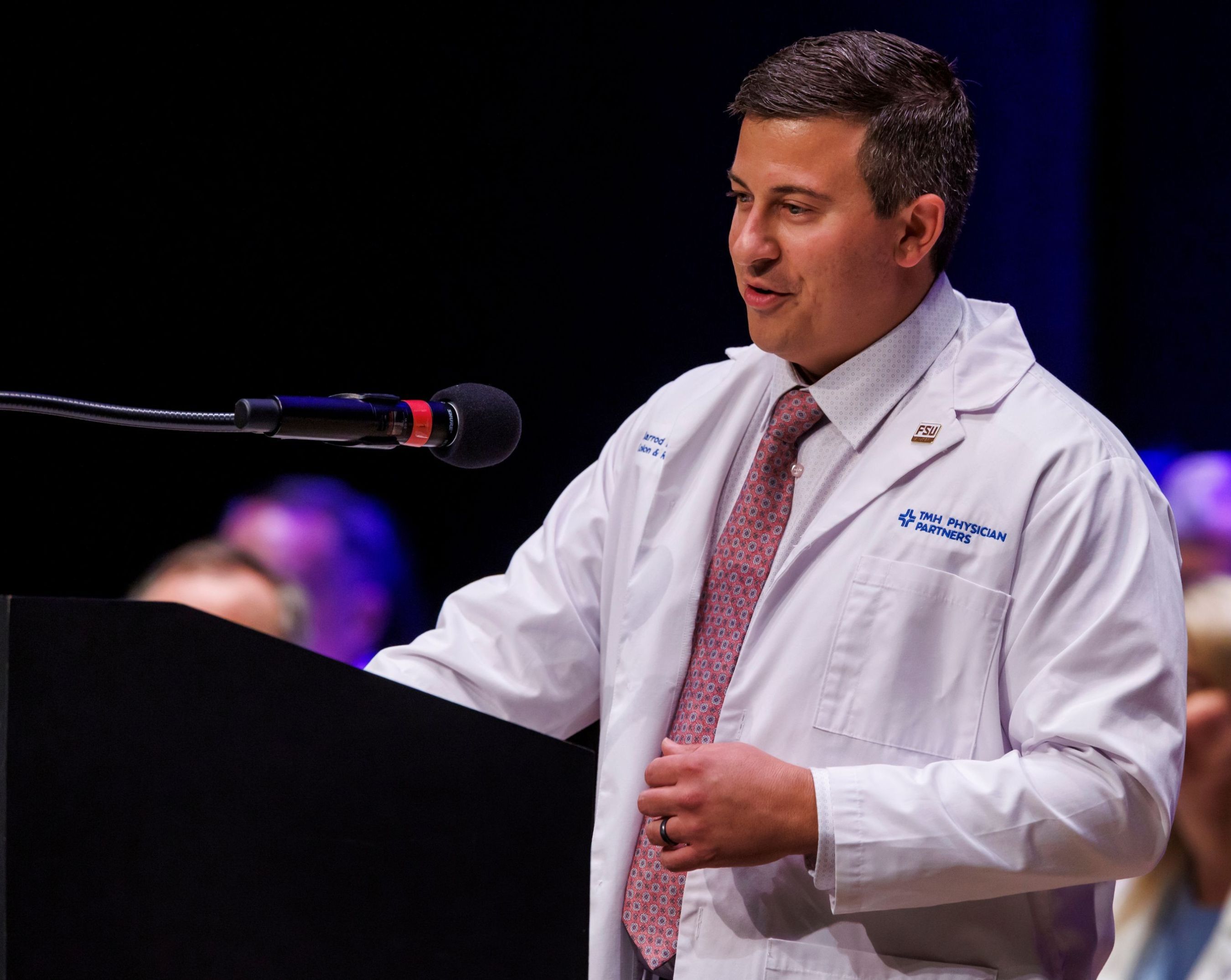
As is tradition, the evening’s keynote speaker was an alumnus and a GHHS member, Jarrod Robertson, an FSU undergrad alum and a member of the M.D. Class of 2017. He completed surgical residency at Memorial Health University Medical Center in Savannah, Georgia, where he served as chief resident, and in 2023 completed a highly competitive fellowship at the Orlando Health Colon and Rectal Institute. When he joined Tallahassee Memorial Healthcare’s Physician Partners – General Surgery three years ago, he became the region’s first fellowship-trained colorectal surgeon with expertise in advanced robotic techniques.
He serves in leadership roles at the TMH Cancer Center, in public health advocacy and in mentoring current College of Medicine students as clerkship faculty. And once he took the podium, he quickly demonstrated he has a sense of humor.
“When the dean asked me to give this keynote, I knew I needed a title that perfectly captured the essence of the journey you are embarking on today. Something inspiring. Something profound.
“So, naturally, I titled this speech: “The Bowel Prep of Medicine,” he said with a slight smile, acknowledging this was not what the students were expecting to hear as they prepared to put on their new white coats.
“Your families are here with cameras. You look sharp. You smell good. And here I am, talking about the most dreaded, unglamorous protocol. But bear with me, because as you sit here today at the starting line, you are about to begin the ultimate bowel prep of your professional lives,” Robertson said.
For the next few minutes, he connected the dots between the exhausting, uncomfortable, behind-the-scenes work of prepping for a colonoscopy with succeeding in medical school. Both require clear vision and an enormous amount of work.
“If you cheat your preparation now, it is your future patients who will pay the price later,” Robertson said, “You aren’t studying to pass a test anymore. You are studying to clear your vision for the person who trusts you with their life.”
He warned the Class of 2030 to prepare for times of discomfort and to remember it’s not a sign of failure but the engine of transformation.
“The grit you develop when you are exhausted is what builds your clinical stamina. The humility you feel when you don’t know the answer is what builds your compassion as a healer. You cannot develop the intuition of a great physician without enduring the friction of the preparation … Trust the process. Embrace the prep.”
As students gathered with family and friends around the Westcott Fountain after receiving their white coats, several people commented that Robertson had nailed the message.
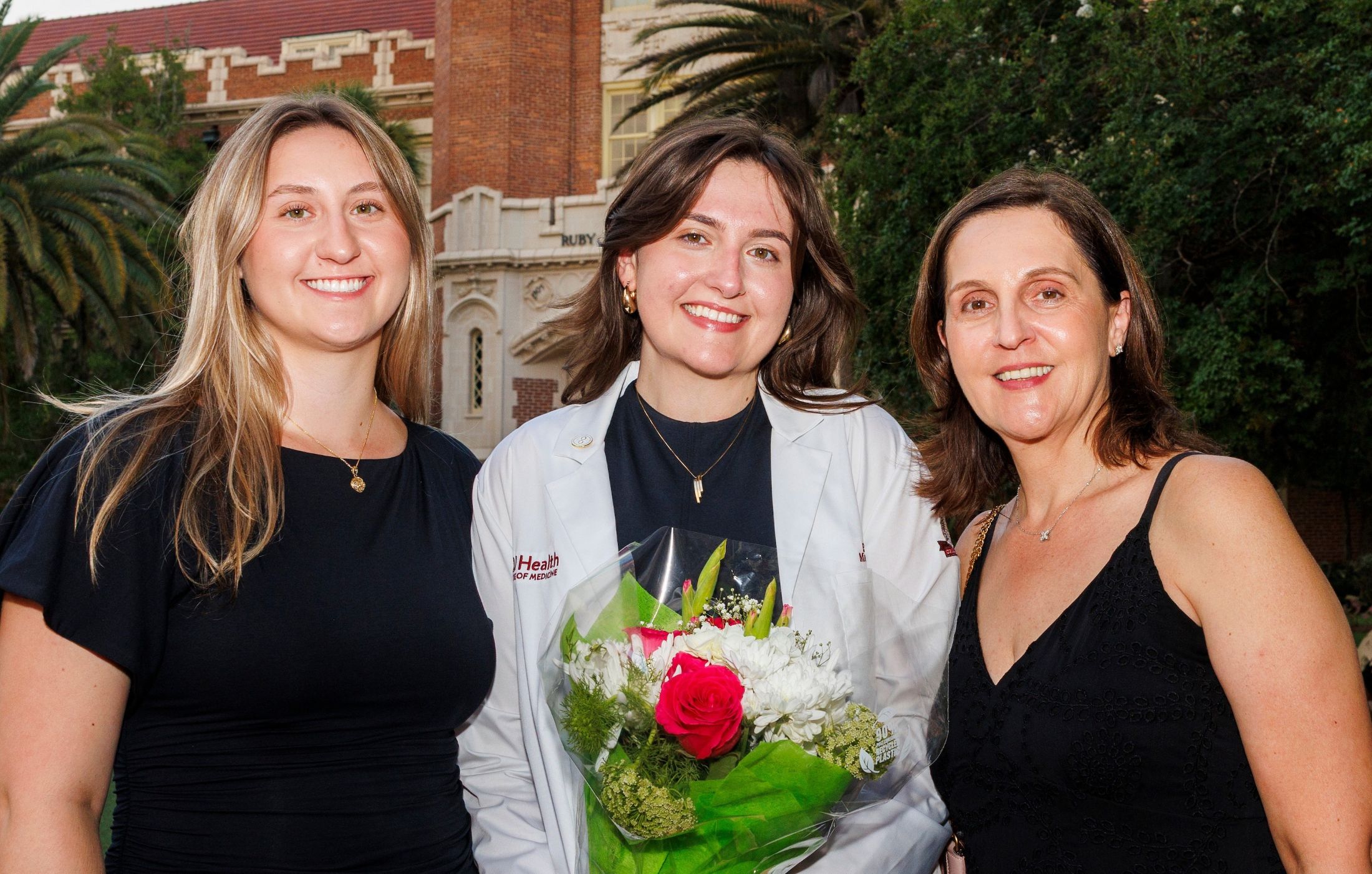
“The first semester is very fast-paced,” said Emma Chirila, whose mom, Andreea, and sister, Diana, were there in support. “It is crazy what we learned in 10 weeks.”
“It was an apt metaphor,” Diana added.
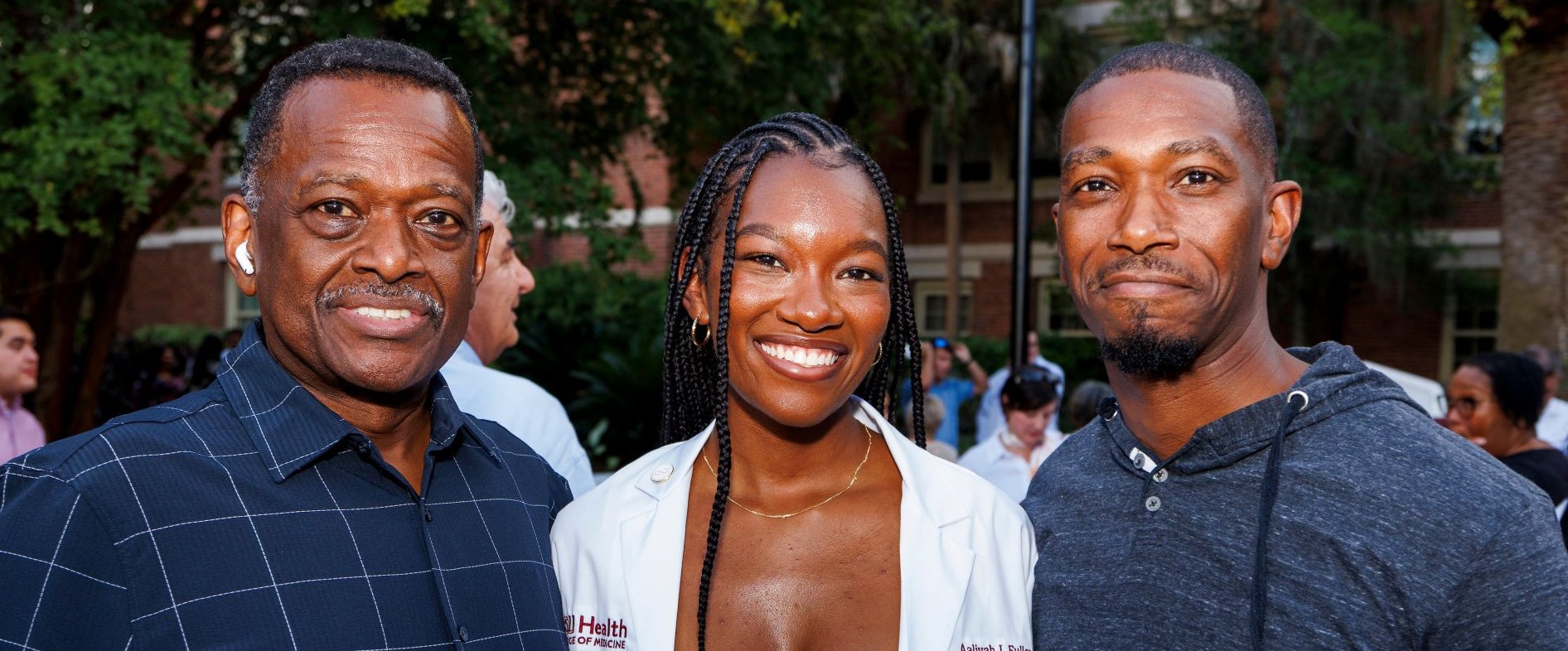
Aaliyah Fuller was bubbling with the joy. As a student last year in the Florida State University College of Medicine’s Bridge to Clinical Medicine Program, where she served as class president, Fuller knew successful completion of the master’s degree program guaranteed admission to the M.D. program, but it didn’t come with a white coat.
“This means the world to me because it’s a symbol of all my hard work,” she said. “I am so proud to be here, and I’m so happy to have made my family proud.”
Gary Fuller, her father, said he couldn't be more proud of her. "She has wanted to be a doctor ever since she was really little."
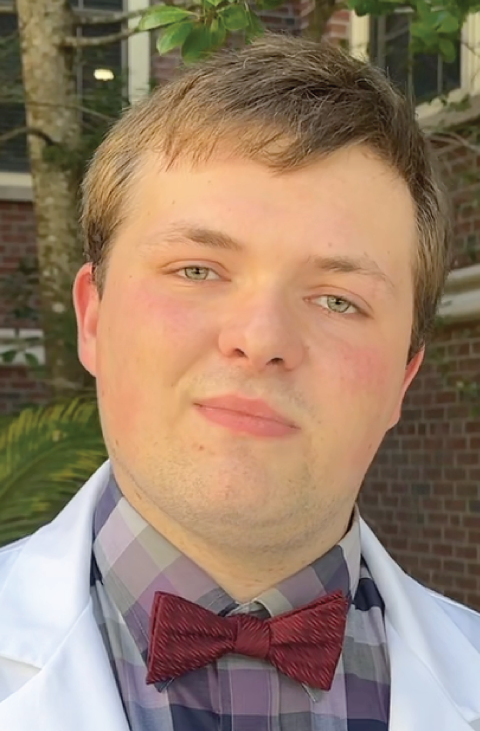
Chandler Grammer, too, has always wanted to be a doctor. As an undergraduate student, he volunteered at the non-profit Health and Hope Clinic in his hometown of Pensacola.
“I got to really experience what it means to give compassionate, patient-centered care. I worked with people from all walks of life, many of them down on their luck. All the patients have no insurance … They are all having a hard time.
“Being able to help the people in my community who need help the most, that’s what it means to wear my white coat.”
Contact Audrey Post at Audrey.Post@med.fsu.edu
Spotlight photo on Home page: Members of the M.D. Class of 2030 prepare to recite the medical student oath after donning their white coats.
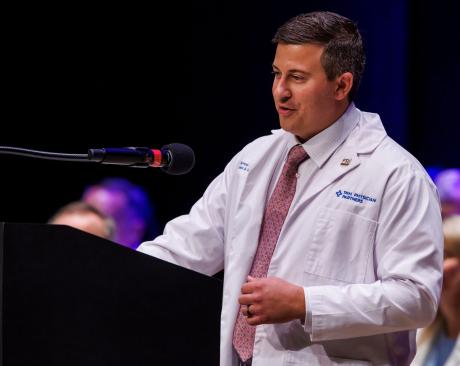
Photo at top right: Keynote speaker Jarrod Robertson, M.D. Class of 2017, addresses the crowd at Ruby Diamond Concert Hall.
(Photos by Colin Hackley of Colin Hackley Photography for the FSU College of Medicine)