

Mathews donates piece of history
December 2010
Some have compared the current U.S. debate over national health-care coverage to the philosophical struggle that took place before and after Medicare was implemented in 1966. One-of-a-kind documents recently donated to the College of Medicine shed some light on the similarities.
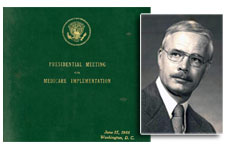
Dr. Charles Mathews, a Tallahassee physician and College of Medicine supporter, attended a June 15, 1966, meeting to discuss Medicare implementation with President Lyndon Johnson. It was the first meeting organized by the White House to discuss how Medicare would be enacted. Now Mathews has donated to Florida State University the binder full of materials he was provided for that meeting.
The materials will be temporarily displayed in the College of Medicine library before being permanently housed in the university’s Claude Pepper Institute on Aging and Public Policy. Apparently this is the only complete set of these documents known to exist.
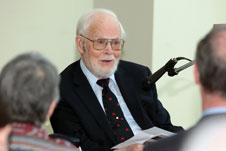
“Neither the Lyndon Johnson Library nor the Library of Congress has a copy of this binder,” Dr. Ken Brummel-Smith, chair of the medical school’s Department of Geriatrics, said at a Dec. 15 reception honoring his friend Mathews.
Julia Zimmerman, dean of University Libraries, called the documents “the kind of thing librarians live for.” Jill Quadagno, of the Pepper Institute, added, “This is a wonderful coup for FSU to have these papers.”
 The idea of a national health insurance plan was first discussed in 1945, when President Harry Truman asked Congress to support the idea. After two decades of debate, with opponents warning about the dangers of “socialized medicine,” the plan shifted toward insuring Social Security beneficiaries and Medicare was born.
Medicare was signed into law July 30, 1965. Truman was the first to enroll.
At the historic 1966 White House assembly to plan for how Medicare and Medicaid would be implemented, Mathews and other practicing physicians were asked to help acquaint the nation’s health-care providers with the new program.
“It was a surprise to have been invited,” Mathews said during the Dec. 15 reception, “… since I had, for several years, been active in organized medicine’s campaigns against ‘socialized medicine.’
“However, on that historic day, I found myself one of about 200 conferees, from all 50 states, seated in the East Room to get the word on the newly enacted Medicare legislation, direct from the president and from his staff. It was an all-day session, very well organized. We departed Washington crammed with much information, each carrying a binder replete with details about the new Medicare.
“Whatever our prior medical/political persuasions, the clear responsibility of us conferees was to return to our communities (in my case, to Rochester, N.Y.) and to help our colleagues, hospitals and others to adjust to the new Medicare, in which, for the first time in history, the federal government provided health care benefits to an entire class of its citizens, to everyone 65 and older.”
The donated items provide a window into the historic creation of Medicare.
“Abigail Adams once hung her washing here in the East Room,” the president told the assembled physicians that day, according to a transcript of his remarks in the binder. “You are not going to hang out any washing here today; you are doing something … your descendants are going to take great pride in recalling.
“We asked you to come here to give us advice on how we can best help to prepare at the community level for as smooth and as successful an operation as can be had…. Then it will be your job to get action at the community level – to solve the problems which could hamper this program….
“One of them arises from compliance with the laws of the land, specifically the Civil Rights Act. In some communities older people may be deprived of medical care because hospitals fail to give equal treatment to all citizens, because of discrimination.”
The binder of materials is featured along with other items from that era, including the pen President Johnson used to sign the Medicare bill. Also on display are selections of historic photos and documents from the Claude Pepper Papers, housed at the Claude Pepper Library. A large percentage of the original briefing materials have been digitized and are being shared with medical and national libraries.
Mathews, in addition to his support of the College of Medicine, has led a lifetime of involvement in public affairs and volunteer work. The former military flight surgeon recently received the Henderson Humanism Award for the volunteer work he performs in Tallahassee.
He recently made a financial contribution to the medical school that, among other things, supports summer research projects by students in the field of aging. He hopes his investment will encourage College of Medicine students to consider geriatrics as a career choice.
“One of our mission areas is care of the aging, and we need to walk that walk,” Dean John P. Fogarty told Mathews. “Your continuing support is deeply appreciated.”