


At Florida Brain Symposium, Alzheimer’s patient gives researchers new perspective
August 2014
Perhaps the most talked-about presenter at the recent Florida Brain Project Symposium was not a brain researcher at all, but a Tallahassee patient.
The keynote speaker was Sandy Halperin — a retired assistant professor at Harvard’s dental school who, since being diagnosed with early-onset Alzheimer’s disease four years ago, has become a national advocate for accelerated research on dementia. He alternately praised the researchers for their work, pounded the lectern out of frustration with a slow-moving Congress and, as if to remind his audience of the enemy they’re pursuing, apologized occasionally for losing his train of thought.
The Brain Project is a consortium effort by universities and research institutions to make Florida known nationwide as the “State of Brain Research.” Besides FSU, the participating institutions include the University of Florida, University of Miami, Scripps-Florida, Mayo Clinic Jacksonville, University of South Florida and Max Planck Florida Institute for Neuroscience.
The July 28-29 Tallahassee symposium was the group’s first. The agenda focused on Alzheimer’s and was also designed to educate legislative aides about brain research, said Richard Nowakowski, chair of the FSU College of Medicine’s Department of Biomedical Sciences, who was one of the symposium planners.
“That Tallahassee was chosen as the venue for the inaugural event is significant, because it implicitly recognizes the capital city’s pre-eminent position in this endeavor,” said Pradeep Bhide, director of the College of Medicine’s Center for Brain Repair and professor of biomedical sciences. “Moreover, this event helps spread the word in our community that the state is focused on brain research as a means of attracting economic and technological prosperity and innovation.”
Bhide was among the symposium speakers with an FSU connection. Among the others were Michelle Arbeitman, Yi Ren and Yi Zhou (College of Medicine), Zuoxin Wang (Department of Psychology) and Debra Ann Fadool (Department of Biological Science).
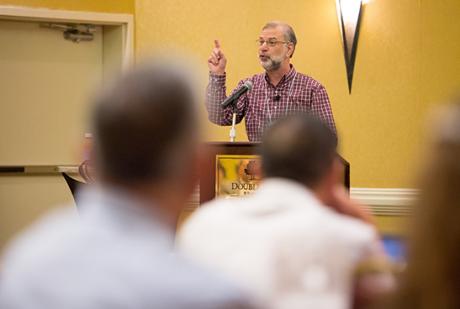
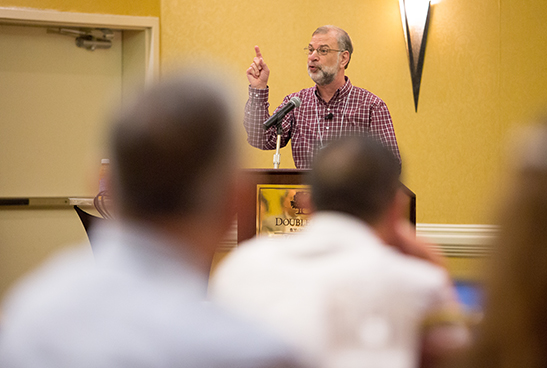
Halperin (pictured here) — who has partnered with the College of Medicine to form The Alexander “Sandy” Halperin, DDS, Alzheimer’s Research Fund — reminded his listeners how difficult it is for someone with Alzheimer’s to wrestle with language. Nevertheless, his message was crystal-clear.
“If I sound frustrated and perturbed during my upcoming comments, I simply and clearly am, and I apologize for this in advance… ,” he said early on. “Make no mistake about it — the dementia tsunami that many refer to is already upon us…. It is time for all of us, including all of the legislators around the country, to put a STOP to these repetitive and recurring conversations of information that is all too well-known and acknowledged — and to replace this seemingly endless talk with action-oriented debates and the funding that is needed to best achieve our nation’s dementia care and research goals.”
Specifically, he wants Congress to have the “guts” to fully support dementia research.
“If a member of the U.S. Congress says to me that they are in support of Alzheimer’s and other dementias,” he said, “the only way that I will believe that they are actually in support of the caring and research is if that member of Congress … goes back into their chamber and figuratively bangs their fists on the lectern in strong support for the billions of dollars of funding that are necessary.
“I know that a few years ago the Alzheimer’s Association had been requesting $2 BILLION in annual funding. But when that was not acted upon for several years, the association reduced what it was asking for to a $100 MILLION increase in funding — to an amount that is not close to the $2 BILLION.”
He also reminded the assembled researchers that their work is vital: “Even if your research is not directly related to dementia, I believe that all brain research is connected and/or linked in one way or another.”
Several researchers thanked Halperin for humanizing the disease.
“Sandy made the participants aware of the acute need for a cure, and made them aware that they were not alone in this fight,” Bhide said. “Most scientific conferences focus solely on research and technical advances. His participation made the Florida Brain Project unique because it crossed those usual limits and made brain research both personal and global at the same time.”
The symposium was made possible by a donation from Drs. Martin and Sandra Fackler.