
Mathews praised at memorial tribute

June 10, 2011
By Ron Hartung
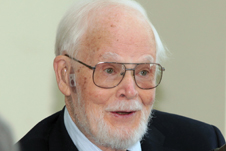
Charles R. Mathews, longtime advocate of health care for everyone and generous friend of the Florida State University College of Medicine, was celebrated in a memorial tribute at the medical school June 9.
“Physician, teacher, mentor, colleague, humanitarian, visionary” was how Dean John Fogarty summed him up to begin the memorial, organized by Karen Wendland of Capital Medical Society; Ray Bellamy, surgery clerkship director at the medical school’s Tallahassee campus; and Ken Brummel-Smith, chair of the Department of Geriatrics. Speaker after speaker told tales of this hard-working, gently persuasive cyclist/physician.
Mathews, who died May 23 at age 88, made donations to the medical school to support student research into geriatrics. He also participated in numerous seminars and conversations with Florida State medical students about the care of older patients, a major emphasis in the College of Medicine. As a result of his funding, Mary O’Meara this year received the American Geriatrics Society Student Presidential Award for a study on quality of life.
Another major emphasis at the medical school is care for the medically underserved, a priority that Mathews demonstrated through his unwavering service at clinics for indigent patients.
“The clinic patients are far from ideal patients,” Mathews said in a recent video interview with Brummel-Smith. “They’re difficult patients. But they deserve the best that we can give them.… I think that health care is an intrinsic human right, but we’re not there yet. It’s going to take a while [to provide universal health care]. I may not see it in my lifetime, but I’m hopeful.”
For nine years, Mathews and his wife, Frances Dwyer, R.N., volunteered at Neighborhood Health Services, providing primary care to indigent patients. He won frequent praise for his medical generosity, including a Volunteer of the Year award from NHS in 2004 and the I.B. Harrison Humanitarian Award from Capital Medical Society in 2007.
“He didn’t take care of poor people,” said Lisa Jernigan, of the Tallahassee Memorial Hospital Family Medicine Residency Program. “He took care of patients who happened to be poor. That way of looking at people was infectious.”
Said retired gastroenterologist James Stockwell: “Charles left us a legacy of compassion.”
He left more than that. In late 2010, Mathews invited the College of Medicine to be the first site to display his rare, historical gift to the Florida State University Libraries. In 1966 he had participated in President Lyndon Johnson’s White House Conference on the Implementation of Medicare, and more than 40 years later he donated a complete binder of materials from that groundbreaking conference – apparently the only such binder still in existence.
“Charles was a bigger-than-life person when I knew him, a truly extraordinary man,” said Bruce Berg, dean of the College of Medicine’s Sarasota campus, whom Mathews hired in the 1970s in Sarasota. “Charles was a teacher and a collaborator, … an organizer, a traveler, a builder, … a sailor, a calligrapher, a singer, a cyclist, an adventurer and a risk-taker. And without doubt a full participant in life…. He taught me what it meant to be responsible for a patient’s life, not just for a day but for many years.”
Back in 1945 was when Mathews obtained his medical degree from the University of Oklahoma. Later came two years of active duty as a flight surgeon with the U.S. Air Force. From 1952 to 1972, he was in private practice in Rochester, N.Y. During that time his practice evolved into pulmonary and critical-care medicine. He was on the faculty of the University of Rochester School of Medicine and president of the county medical society.
In 1972 he moved to Sarasota, where he founded the multi-physician group Pulmonary Associates. He was on the clinical faculty of the University of South Florida School of Medicine in Tampa. He was elected chief of the medical staff at Doctors Hospital of Sarasota and then at Sarasota Memorial Hospital, where in 1984 he set up the office of vice president for medical affairs.
In 1989 he and his wife made Tallahassee their home when he took a job with the state Department of Corrections. In Tallahassee he remained as active as ever. Besides volunteering at Neighborhood Health Services, Mathews was instrumental in arranging for dental services to be provided to the medically indigent through the We Care Network of the Capital Medical Society.
Upon his death, his obituary requested that memorial donations be made to the We Care Network or to the College of Medicine, for geriatrics studies.
“Charles was, for me, one of the prime examples of why I went into geriatrics,” Brummel-Smith said. “He showed that age doesn’t make a difference. It doesn’t make a difference physically because you change in order to fit your physical needs…. You learn from your mistakes. You change your attitudes. You support other people. All of the great things about aging, Charles showed.”
Wendland recalled a slogan of Mathews’ that has stuck with her: “If you rest, you rust.” Berg summed up his energetic former mentor in six words: “Been there, done that. What’s next?”
Watch Ken Brummel-Smith’s interview with Charles Mathews about Medicare, the physician’s responsibility to the medically indigent and more.
Read about the historic Medicare documents that Charles Mathews donated to Florida State University.