

FSUCares busy during spring break
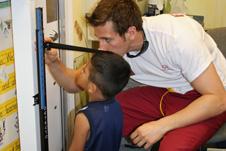
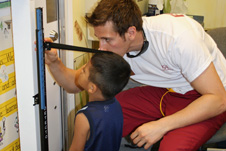
When it’s spring break, don’t look for the students of FSUCares on a beach or at a bar. This year, like every year since the Florida State College of Medicine welcomed its first class in 2001, these students were giving out medical supplies and treatment – and getting a cultural education in return.
Fourteen first- and second-year College of Medicine students made the annual trip, along with six faculty members and one alumnus who’s now in residency. They split into three groups: one in Immokalee, southwest Florida; one on the Texas-Mexico border; and one in a village in Panama. Spring break was March 7-11, but these students departed a few days early. They packed up the medical supplies and clothing donated by the Tallahassee community, and they brushed up on their Spanish.
FSUCares’ mission is to increase outreach to underserved communities, said Elena Reyes, faculty adviser. She also is the director for the “Cross-Cultural Medicine” course, an elective designed to help students develop the knowledge and skills to work with Florida’s underserved Latino community.
“In Panama, we will be working in the clinic that we helped build through donations in the small Filipina village,” Reyes said before they departed. “The theme for the 10th-anniversary trip is long-term community partnership through service-learning.”
These were the people at each site:
- Immokalee – faculty members Reyes, Ph.D., and Curtis Stine, M.D., and students Nathalie Gutierrez, Alexander Gaukhman, Bethann Mohamed and David Swoboda.
- South Texas, at (but this year not across) the Mexico border – faculty members Jon Appelbaum, M.D., and Angel Brana, M.D., and students Charles Clark, Andrew Fritze, Tara Gonzalez and Richard Sims.
- Filipina, Panama – faculty members Ken Brummel-Smith, M.D., and Mark Stavros, M.D.; resident Charles Ritchie (M.D., ’08); and students Keerti Dantuluri, Matthew Heimann, Amanda Morden, Shannon Scott, John Thomas and Melissa Velarde.
The FSUCares officers – Mohamed, Velarde, Sarah Weaver and Raquel Olavarietta – were especially busy with planning, fundraising and packing. Even those officers not making the trip themselves this year worked hard for its success. For many students, there’s a personal connection.
“I came from a very similar background as the people I help today,” said Mohamed, the organization’s president. “Even though I was born in the U.S., I moved to Egypt as an infant with my mother. I saw firsthand the costs of poor health care – losing my mother when I was 5 years old. We moved back to the U.S. when I was 8 years old, and that’s when I had my first doctor’s appointment.
“When I visited Panama during spring break last year, it brought back a wave of emotion. There were 11 of us staying under one roof, in what would soon become the small village’s clinic. The floors were concrete and walls were thin. Electricity was touch-and-go, and the shower had no temperature control. This was a page out of my childhood.”
This year, Mohamed expected Immokalee to be somewhat anticlimactic. Not so.
“There’s more of a need there than there is in Panama,” she said of the migrant workers in Immokalee. “They’re very ill because of the work they do, the pesticides, the lifestyle. High blood pressure, diabetes that’s uncontrolled, alcohol abuse. There’s no money, so they get depressed. Then they turn to drinking.”
At one point during this year's trip, she picked up a bucket filled with produce – and got a sense of how much physical strength a farm worker must have.
“It boggles my mind that they get paid so little, because no American, I feel like, would do this work. I know I wouldn’t do this work. Not because I’m too good for it – it is hard. It is really hard!
“There are serious problems right here in our own backyard. I had no idea.”
Reyes, looking over the mountain of donated clothing and the boxes of other items as they were being packed up for the trip, saluted the generosity of the College of Medicine’s faculty and staff.
“They are the ones that spend the year remembering to bring in toiletries from all their trips, participating in the fundraisers and bringing in the tons of clothes that we are taking,” Reyes said. “I just think it is very special that the staff get so involved and give so much.”