


Fulbright Scholar focuses on patient safety
Dec. 7, 2010
Fulbright Scholar from Uzbekistan focusing on patient safety
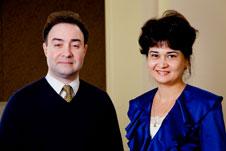
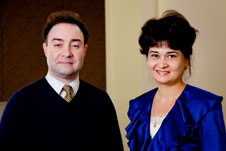
TALLAHASSEE – Nadira Muratova, a physician and health researcher from Uzbekistan who will explore patient safety here through October 2011, is the College of Medicine’s first Fulbright Scholar.
“The Republic of Uzbekistan health care system has just started to develop a system of quality control and quality assurance,” Muratova wrote in her Fulbright project proposal. “We are just at the beginning of the development of standards.”
One year from now, she wrote, she can return to her country and begin to “help other doctors to make their own research in the field of patient safety and try to collect information on adverse events in one of the national hospitals for further implementation of prevention and hospital risk management.”
Her mentor at the College of Medicine, Center on Patient Safety Director Dennis Tsilimingras, is delighted that she’s here.
“My hope,” he said with a smile, “is that when she returns to Uzbekistan, she will become the mother of patient safety.”
Muratova has earned M.D., MPH and Ph.D. degrees and previously was a senior lecturer at Tashkent Institute of Advanced Medical Education (TIAME). In Tallahassee since mid-October, she already is involved in one of Tsilimingras’ projects.
“It’s a small project that’s funded by the College of Medicine,” he said. “We’re identifying adverse events at the time of birth, and we’re trying to differentiate the ones that are preventable and the ones that are not preventable – and then also identify the different types of birth-related adverse events.”
Muratova is getting up to speed as quickly as she can.
“I need to learn the methodology first and also the types of adverse events that result from medical errors – and how the specialists here learn and how they collect information,” she said.
“After that, I hope to develop some protocols to collect information about adverse events. And maybe the first step should be collecting information on hospital-acquired infection. There are no exact figures, but in my experience it’s common in my country.
“I also hope to observe and train in hospitals in Orlando as a patient safety manager. Another task is very important also; it is the development of a curriculum to teach patient safety to students, residents and doctors.” Tsilimingras will share with Muratova his experiences from his recent development of a patient safety curriculum for students at the College of Medicine.
Uzbekistan, formerly part of the Soviet Union, is north of Iran and Afghanistan. Tashkent, its capital, is a city of more than 2 million people. At TIAME, Muratova said, “We have a very long history, since 1932, and very well-qualified faculty.”
It’s a long way from Tashkent to Tallahassee. The seeds for this journey were sown 10 years ago, when Muratova attended a train-the-trainers session at the University of South Florida College of Medicine. There she met Daniel Van Durme, a family physician who was on the faculty there – and now is chair of the Department of Family Medicine and Rural Health at Florida State.
"A few years later,” Muratova recalled, “Dr. Van Durme came to Tashkent with the mission Heart to Heart. It was a big humanitarian action, and family doctors from the U.S. came to give lectures and brought some humanitarian goods for Uzbekistan clinics.”
They kept in touch. Last year, when she applied to the Fulbright program and needed a host university, Van Durme, Tsilimingras and Les Beitsch, director of the Division of Health Affairs, wrote in support of her and agreed that the College of Medicine would be her host.
She knows that she’ll have much work to do when she returns home. Like patient safety advocates in other countries, she has encountered some resistance from the medical establishment.
"But the president of my university is very excited to start something,” she said.
In the meantime, Tsilimingras hopes early next year to help the College of Medicine launch another project, which will offer Muratova another opportunity to study patient safety research methods. He has submitted a proposal to the Agency for Healthcare Research and Quality to study adverse events among recently discharged hospital patients – including rural patients.
Eventually, he said, faculty from the College of Medicine might travel to Uzbekistan to help patient safety gain acceptance.
“This is a great opportunity for me,” he said, “to also learn about what goes on in the world outside of the United States.”