


BMS' Sumajit, Owutey shine brightest in 3MT™ competition
By Patience Moseley
FSU College of Medicine
For most researchers, major breakthroughs usually happen over years. For Sophia Owutey and Hyeje Sumajit, Biomedical Sciences students at the FSU College of Medicine, that timeframe was shortened to just 180 seconds.
Each spring, the Three Minute Thesis, 3MT™, competition at FSU gives graduate students the opportunity to explain their work and its impact to a non-specialist audience using only one static slide in three minutes. Winners are selected based on their ability to clearly and enthusiastically emphasize and explain the significance of their work, their research strategy and results, and the impact of their findings in 180 seconds.
Three minutes, one slide, two BMS winners.
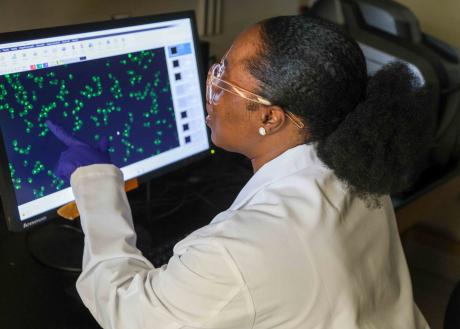
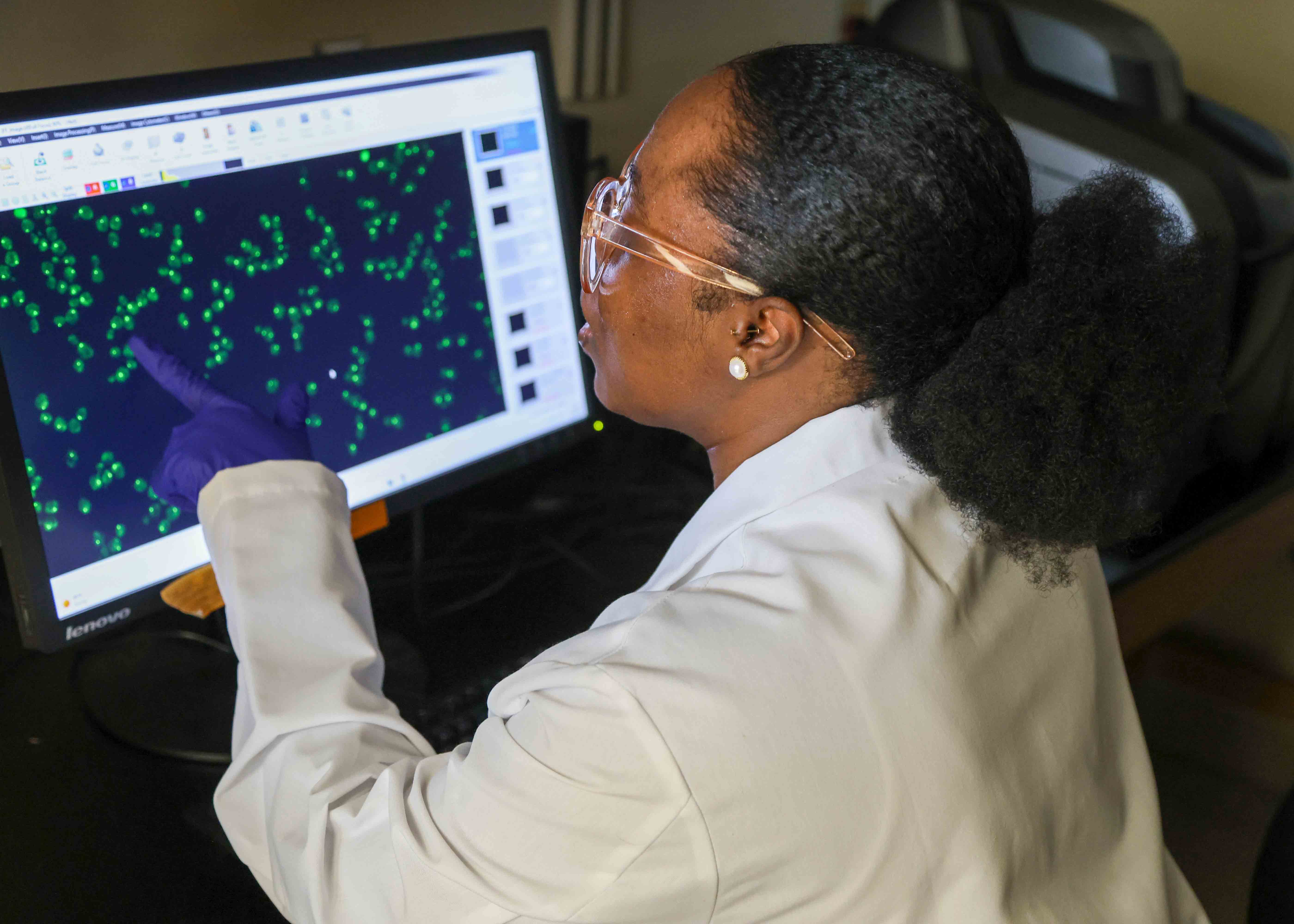
Third-place winner, Sophia Owutey, spent the weeks ahead of the university-wide competition practicing her elevator pitch. “I had been so nervous leading up to the competition,” she said. “I practiced in the bathroom because I could hear my voice in there.”
A second-year doctoral student in the Wang Lab, Owutey studies how protein signals are involved in DNA repair in yeast cells, which repair DNA similarly to human cells.
“In your cells, sunlight damages your DNA and that damage could lead to cancer. . . thankfully, our cells have an emergency response crew. This repair crew cannot come without the right signals,” she explained. Her work focuses on a specific signal that recruits the “emergency response crew” to the damaged DNA site for repair.
After standing out among 12 other FSU graduate students at 3MT™, Owutey is shifting her focus to prepare for qualifying exams, aiming to reach doctoral candidacy this summer.
Sumajit, a third-year doctoral candidate in the Irianto Lab and first-place winner of the FSU 3MT™ competition, humbly shared her pathway to a successful presentation.
“Qualifying exams helped me develop useful skills. You need to really know what your committee is asking you, and that’s the hardest part,” Sumajit said. “Having the background knowledge from qualifying exams really helps me explain my research better, and it helped a lot with Three Minute Thesis.”
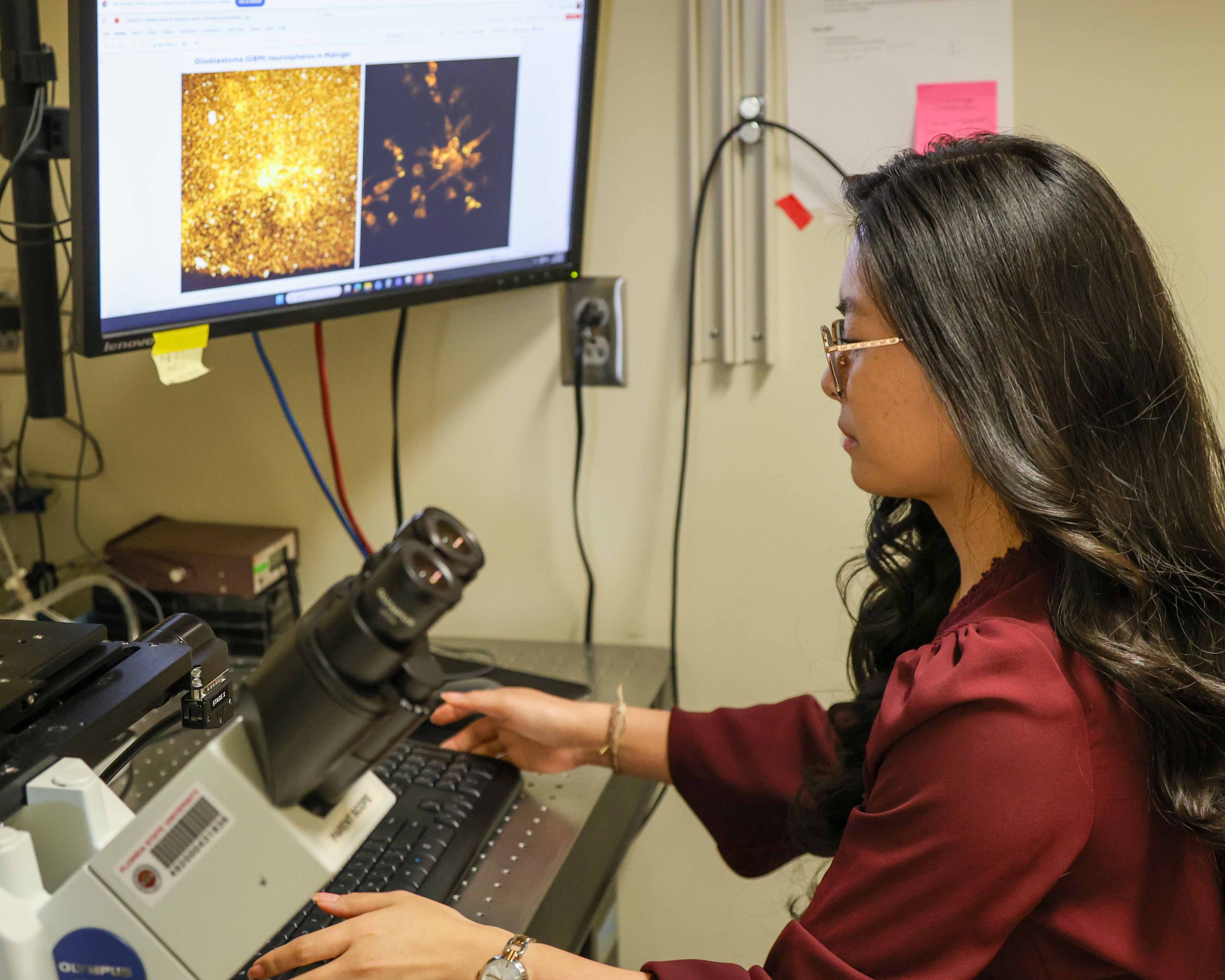
In addition to winning the competition, Sumajit also claimed 3MT™ People’s Choice honors, voted on by the audience for the relatability and engagement of her presentation. Sumajit explained her research, focused on glioblastoma cell migration, as if the cells were a rock climber using force generated from the pull of their arms and push from their legs to scale difficult landscapes. Although glioblastoma cells don’t have arms or legs, they generate similar forces, allowing them to physically migrate deep into brain tissue. These forces are what she measures in patient-derived organoids using a method called traction force microscopy, or TFM, to characterize the cellular interactions as they invade healthy tissue.
Only 7% of patients diagnosed with glioblastoma survive for more than five years. Even surgical removal of the tumors doesn’t typically stop the spread; the cancer cells move so deep into healthy tissue that the tumor, in its entirety, cannot be removed. Sumajit is determined to understand how these cells move and what helps them “decide” where to go.
“If we know how these cells behave, if we can identify the main players involved in this process, we can try to block it,” she said. “And if we can block it, we can stop the spread, give patients more time.”
Now, Sumajit is taking that message of hope on the road to Gainesville to compete in the state 3MT™ competition at the University of Florida, April 22-24 . There, she’ll be showcasing the work and the scientific talent found in FSU’s BMS program.
For students considering the 3MT™ competition in the future, Owutey and Sumajit offer simple advice – understand your work, practice, and know your audience.