

College of Medicine gets national praise for nutrition curriculum
Federal health officials lauded the Florida State University College of Medicine Thursday for championing the integration of nutrition education into medical training during an event hosted by the U.S. Department of Health and Human Services (HHS).
Secretary Robert F. Kennedy Jr. commended FSU for its proactive approach to the burgeoning chronic disease crisis. Kennedy, along with Education Secretary Linda McMahon and National Institutes of Health Director Jay Bhattacharya, called on the nation’s medical schools to implement a minimum of 40 hours of nutrition education for medical students.
“Chronic disease is overwhelming our country, and it is accelerating,” Kennedy said, specifically noting that FSU President Richard McCullough and College of Medicine Dean Alma B. Littles, M.D., were early champions of focusing on nutrition education.
“Florida State University President Richard McCullough and Dean Alma Littles, along with Dr. Gold [from University of Nebraska], were the first to encourage and embrace this tremendous initiative,” Kennedy said.
Poor diet directly correlates to a variety of health problems. A 2024 policy brief written for the journal Frontiers in Public Health noted that about 1 million people die annually from diet-related chronic diseases.
The FSU College of Medicine has been at the vanguard of incorporating nutrition education into all four years of medical training with courses on how nutrition impacts immune, cardiovascular, renal and endocrine systems. This also includes an emphasis on using nutrition to prevent common chronic diseases, such as atherosclerosis, osteoporosis, diabetes, as well as a variety of metabolic disorders.
The college currently requires 42 hours of nutrition education as part of its curriculum.
“The Florida State University College of Medicine was created, in part, to expand access to health care across the wide variety of communities in our state, many of which are disproportionately vulnerable to the very chronic diseases that proper nutrition can help manage and even prevent,” Littles said in a statement after the event.
“We are proud that, for almost 20 years, we have been providing a robust, fully integrated program of nutrition education that exceeds the minimum standards this initiative sets, and we are committed to enhancing the role of nutrition in medical training even further," she continued. "Proper diet, nutrition and metabolic health can improve health outcomes in every population.”
Nutrition and human performance have been a major focus of not only the College of Medicine’s curriculum but also the university’s research enterprise.
In 2025, the university launched the Institute for Connecting Nutrition and Health, led by National Academy members Regan Bailey, National Academy of Medicine, and Patrick Stover, National Academy of Science. The institute serves as a hub for research aimed at using food-based solutions to solve complex health challenges.
This built on years of work across the university in nutrition, exercise science and human health.
Faculty at the Anne Spencer Daves College of Education, Health, and Human Sciences are investigating the benefits of functional foods on gut health, cardiovascular health and more. The Institute of Sports Sciences and Medicine, established more than 15 years ago, explores how nutrition and exercise affect longevity, health and performance.
“Nutrition research has long been a major component of our research enterprise at FSU,” said Vice President for Research Stacey S. Patterson. “We have invested in our nutrition and human performance work because we believe that part of our role as a public research university is to use the best science available to find solutions for people facing complex health challenges.”
For more on the FSU College of Medicine’s efforts on nutrition education in medical training, visit the college’s website at https://med.fsu.edu/nems/home.
Contact Kathleen Haughney at khaughney@fsu.edu
Photo captions:
Spotlight photo on Home page:
From left, Professor Regan Bailey, Ph.D., founding director of FSU’s Institute for Connecting Nutrition and Health (ICON-Health), U.S. Health and Human Services Secretary Robert F. Kennedy Jr., College of Medicine Dean Alma B. Littles, M.D., and Professor Patrick Stover, Ph.D., founding director of ICON-Health. Kennedy posed for a photo with the FSU delegation after a press briefing on expanding nutrition education in medical school curricula on Thursday, March 5, in Washington, D.C. (Photo courtesy of Regan Bailey)
Photo at top right:
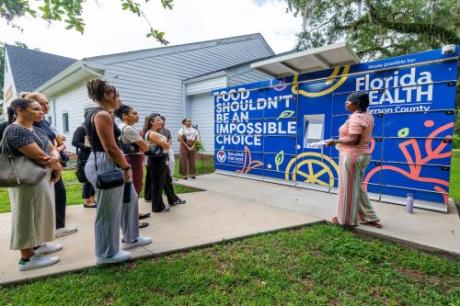
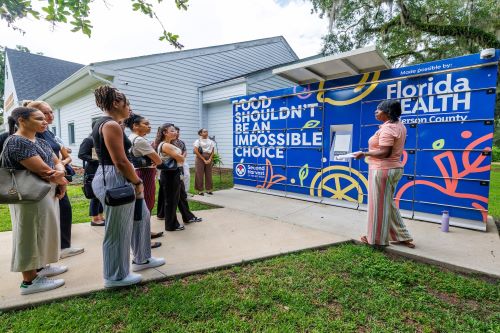
Part of FSU medical students' first semester training is the Rural Learning Experience, known as the RuLE Trip. Joined by students in the Bridge to Clinical Medicine and PA programs, as well as selected undergraduate students, the M1students get a closer look at healthcare issues, including food insecurity and poor nutrition, in rural communities in the Florida Panhandle and Big Bend. Here, Nita Mitchell, the community health program manager at the Jefferson County Health Department in Monticello, discusses the Food Pantry and how it serves those most in need. It sits adjacent to the Health Department. (Photo by Colin Hackley for the FSU College of Medicine.)