

'Rising Star' continues to rise as researcher, educator, mentor
As Florida State University continues to rise in stature as a research university with an R1 classification, the College of Medicine plays a key role in that growth.
R1, the highest level in the Carnegie Classification of Institutions of Higher Education, indicates very high research activity as well as a high number of doctoral graduates, and the college’s growing faculty excels at both researching and mentoring.
For a shining example of the caliber of faculty the College of Medicine is attracting, look no further than Yang Hou, Ph.D., an assistant professor in the Department of Behavioral Sciences and Social Medicine.
Hou’s multiple awards – not only here but also at the University of Kentucky, where she spent three years before coming to FSU, and from professional organizations including the American Psychological Association – are a testament to her passion for research, teaching and mentoring. In 2022, the year she joined our faculty, Hou was named a Rising Star by the Association for Psychological Science.
In fiscal year 2025 alone, Hou earned the College of Medicine’s Outstanding Junior Faculty Researcher honors and a Florida State University Inclusive Teaching and Mentoring Award. She was one of two people honored for fostering inclusive learning environments and providing exemplary mentorship both inside and outside the classroom.
For Hou, a former school psychologist who earned a doctorate in Human Development and Family Sciences at the University of Texas at Austin, she’s simply “paying it forward.”
“Supportive mentors who embraced my cultural background and recognized my potential were critical to my success. I know how transformative good mentorship can be,” she said. “Through structured, inclusive and evidence-based mentoring, I help students build research proficiency, leadership skills and commitment to addressing health disparities.
“Supporting their growth is one of the most rewarding parts of my work.”
Hou researches neurofibromatosis type 1, a genetic rare disease affecting about one in 3,000 people worldwide that is usually diagnosed in childhood. She first learned about the disease while a postdoctoral fellow at the National Cancer Institute, a division of the National Institutes of Health, and it deepened her interest in understanding how unpredictable diseases affect individuals and their families.
NF1 causes tumors to grow on nerves throughout the body, including the brain and spinal cord, and is characterized by changes in skin pigmentation. Complications can be life-limiting as well as shortening the life span by eight to 15 years. There is no cure. Treatment consists primarily of managing the symptoms, which can cause trouble with learning, cognition and behavior, heart and blood vessel conditions, vision loss and pain.
In her letter nominating Hou for the college’s Junior Faculty Researcher award, Professor Heather Flynn, Ph.D., Hou’s department chair wrote, “Dr. Hou’s research is trailblazing in its application of advanced quantitative methods to explore the neurobehavioral impact of NF1 throughout the various life stages.”
Flynn said one of Hou’s projects, funded by the Department of Defense (DoD), “is especially groundbreaking as it establishes the first comprehensive neuropsychological dataset for children and adolescents with NF1. Collaborating with 12 top researchers from around the world, Dr. Hou has tackled the common problem of sample sizes in rare disease research.”
The dataset the team created enables detailed analyses of neurobehavioral changes with age, identification of distinct subgroups and their observable traits, and insights into how cognitive, academic, socioemotional and behavioral functions are interrelated in NF1.
Hou’s SMART-NF1 project, funded by an FSU Council on Research and Creativity Seed Grant and the Florida Institute for Pediatric Rare Diseases, uses smartphone and wearable technology to capture real-time cognitive and emotional functioning and daily activities in adolescents with NF1.
Hou also directs two major studies on cognitive aging in adults with NF1, funded by the Children’s Tumor Foundation and the DoD, creating the first comprehensive datasets to identify both risk and protective factors for late-life cognitive function. In parallel, she collaborates as a statistician on clinical trials testing interventions to improve mental and physical health.
“The broader impact of Dr. Hou’s work is substantial,” Terra Bradley, Ph.D., assistant dean for research administration and senior research associate, wrote in another of the three nominations for Hou as outstanding junior researcher. “Her findings are providing a roadmap for clinicians and families to better manage patient care, as she is identifying critical developmental periods when neurobehavioral challenges are likely to surface.
“This will enable timely implementation of support strategies that can positively impact quality of life.”
In addition to building a portfolio of interdisciplinary funded research from federal, private and internal FSU sources, Hou also has published 23 articles, seven as first or co-first author and another four as senior author, in her short time here. In total, she has published more than 50 peer-reviewed papers in top-tier journals such as American Psychologist, Journal of the American Academy of Child and Adolescent Psychiatry, Pediatrics, Neuroscience & Biobehavioral Reviews, Neuropsychology Review, Child Development, and Developmental Medicine & Child Neurology. She also serves on the editorial boards of a number of psychology journals.
Not surprisingly, she makes sure her mentees – undergrads, graduate students, medical students, and postdocs – have ample opportunities to gain publication and presentation experience and build expertise.
Professor Angelina Sutin, Ph.D., a BSSM research collaborator and a prolific researcher and publisher herself, describes Hou as “a fantastic colleague” and a “great asset.”
“As a scientist, she brings tremendous expertise to the department and the college,” Sutin said. “She is generous with her time and expertise to her trainees, as well as other faculty. It has been a pleasure to watch her succeed. I look forward to see what she accomplishes next.”
For her part, Hou describes Sutin as “an invaluable mentor, inspiring my work in aging and providing generous guidance on grant writing and career development.”
Colleagues describe Hou as having a quiet dignity, of being ambitious but not in an obnoxious way, and of being kind and supportive, always there and ready to help. Some even wonder when she sleeps.
So what fuels this dynamo?
“I grew up in a small, impoverished village in Sichuan, China, where only three of more than 20 children in my age cohort went on to college. I was the first in my extended family to pursue higher education and the only one to complete graduate training,” Hou said. “Witnessing the diverse and often difficult paths of peers – including early parenthood, incarceration, and even tragic loss – sparked a lifelong curiosity about what shapes human development and why people’s life trajectories diverge.
“That question led me to psychology, with a goal of helping individuals overcome challenges and achieve better outcomes.”
She wrestled for years whether to stay a practitioner or become a researcher, ultimately choosing the latter.
“My doctoral work focused on how environmental and social factors — such as discrimination, immigration and socioeconomic adversity — affect children and families, particularly those from marginalized backgrounds.”
Hou founded the Development, Environment and Resilience (DEaR) Lab at the College of Medicine, which bridges developmental, clinical and quantitative psychology.
“My lab’s mission is to advance equitable, evidence-based approaches to mental health and well-being, particularly for underrepresented groups such as individuals with genetic disorders,” Hou said.
“Ultimately, I hope my legacy will be twofold: advancing science that improves the lives of individuals among underserved groups, and cultivating the next generation of interdisciplinary researchers committed to equity, resilience and mental health.”
Photo captions:
Spotlight photo on Home page: Assistant Professor Yang Hou, center, poses with her post-doctoral fellowship mentor at the National Institutes of Health's National Cancer Institute, Pamela Wolters, Ph.D., and a post-doctoral scholar in her FSU lab, Matthew Jamnik, Ph.D., at the 2025 NF1 conference earlier this year in Washington, D.C. Wolters introduced Hou to clinical research and the field of neurofibromatosis Type 1, and she continues to collaborate with her on research. (Photo courtesy of Yang Hou.)
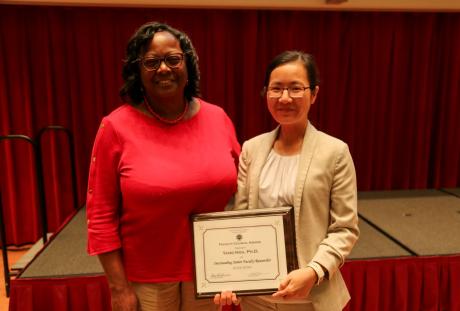
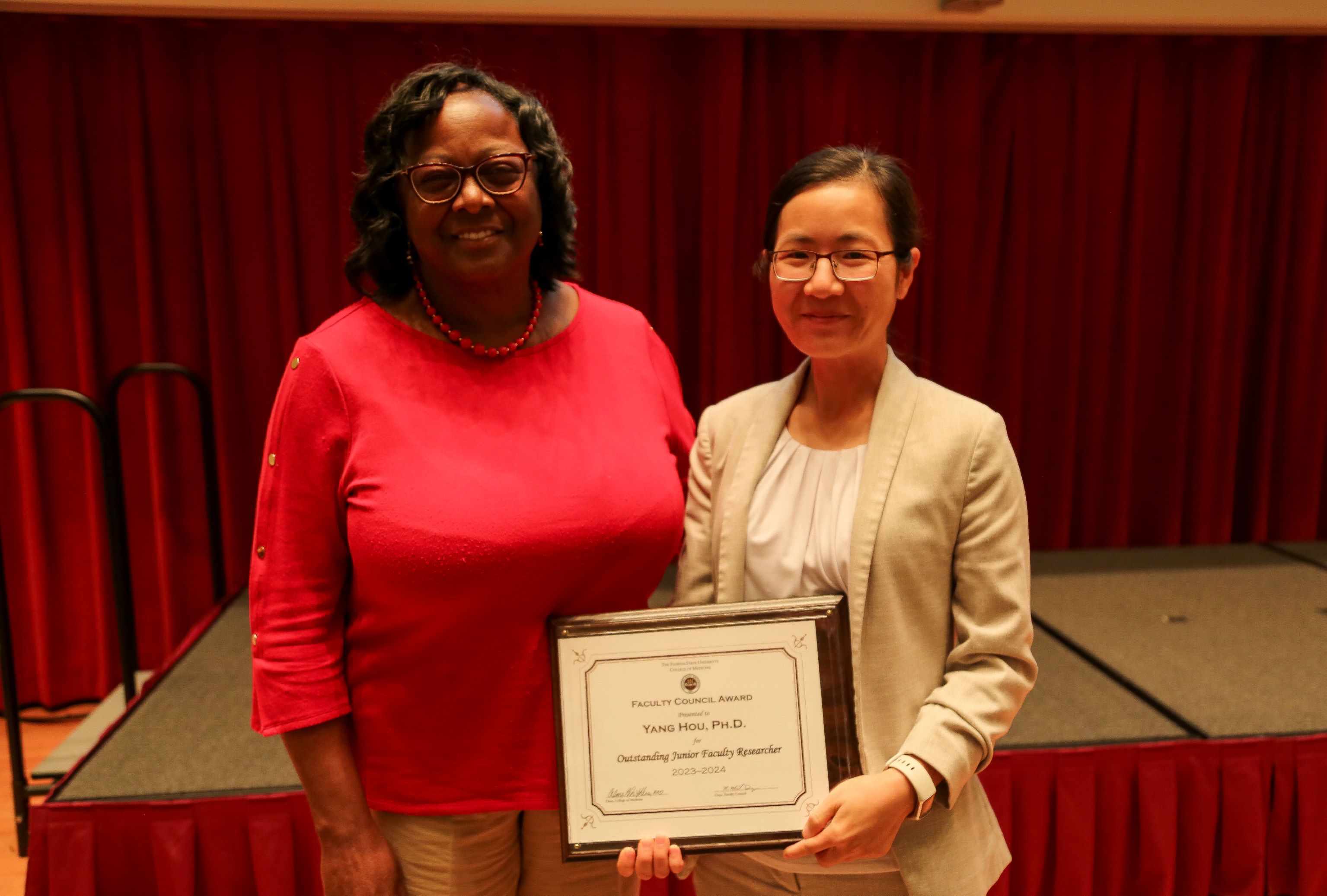
Photo at top right: FSU College of Medicine Dean Alma Littles, M.D., poses for a celebratory photo after Assistant Professor Yang Hou was named College of Medicine Outstanding Junior Researcher for academic year 2023-2024.
(Photo courtesy of College of Medicine Creative Services team)