Spring 2026

Apr 28, 2026

Winter 2026

Mar 03, 2026

News of the Week

Remapping the blueprint for DNA Repair

By: Patience Moseley
FSU College of Medicine

Roughly 20 million people receive a cancer diagnosis each year, and an estimated 1-in-5 people will receive a cancer diagnosis in their lifetime. Cancer cells arise from damage to the cell’s instruction manual – DNA. 

Our cells contain natural repair machinery that, under normal conditions, can cut out the damaged DNA and fill in the blanks to provide working instructions, preventing healthy cells from becoming cancer cells. Failure to repair DNA damage can lead to cancer cell growth and division. In fact, many cancer cells use the same, but deficient, repair machinery. When these repair systems do not function properly, DNA damage can persist and additional mutations can accumulate.

Researchers in the Department of Biomedical Sciences at Florida State University’s College of Medicine are changing the way scientists think about the DNA repair process, paradoxically, a key player in both cancer prevention and growth. 

For decades, scientists thought that polymerase beta (Polβ), one of the main players in the repair machinery, would form multiple temporary bonds with the DNA during the process.

It was thought that Polβ would bind to the DNA strand, cut out the incorrect sequence, break the bond, and bind again to fill in the blanks.

It seems that may not be the case. 

One research team, led by Eminent Professor and Dorian & John Blackmon Chair in Biomedical Science, Zucai Suo, Ph.D. has discovered that Polβ forms a chemical bond with DNA, and proceeds with cutting and repairing the damaged DNA while covalently bonded, or crosslinked, to the strand. By remaining attached during this critical stage of repair, the enzyme is less likely to disengage before the repair process is complete.

“We found that crosslinked Polβ actually enhances the flux — so, basically, enhances its likelihood to move forward and complete the reaction,” said Daniel Betancourt, a doctoral candidate and the lead author on the team’s publication in Nucleic Acids Research. “So that changes a lot; Polβ has only really been studied when the DNA is not covalently linked to the enzyme.”

Using these findings together with X-ray crystallography snapshots, the Suo lab established a kinetic model that outlines the different step-by-step process for DNA repair while chemically attached to the strand. The model revealed that important repair activities occur while the enzyme remains covalently bound to DNA, a state that had received relatively little attention in previous studies. In this case, Polβ doesn’t detach, or dissociate, after the initial bond is formed; it’s work is done while it’s bound to the DNA.

This work, published in June 2026, provides a wider-angle view of DNA damage and repair and lays the foundation for future research to explore how this process occurs naturally and how different forms of DNA damage might influence the repair process. 

With these findings in mind, the Suo lab hopes to determine how the initial crosslinking reaction between Polβ and DNA occurs and how that bond sets the stage for successful DNA repair. Their work also establishes a foundation for future studies of at least five other human DNA polymerases involved in DNA repair and damage bypass.


Schematic of crosslinked DNA and Polymerase beta from the Suo lab's recent publication.

Schematic from a figure in the Suo Lab's recent publication shows the crystal structure of Polβ and DNA crosslinked complex.

Dean's Message Summer 2026

May 29, 2026

A new era for patient care, medical education and research

Dear Students, Faculty and Staff:


On March 11, the Tallahassee City Commission took a historic step and voted to approve the transfer of city-owned Tallahassee Memorial HealthCare assets to Florida State University. Later in March, the FSU Board of Trustees and the Florida Board of Governors endorsed the transfer, clearing the path for something truly transformative: the creation of an integrated academic health center in the state’s capital city.


Academic Health Center on TMH Campus that is under construction. Most of the exterior is up.
Construction continues on the FSU Health Research Center on the TMH campus.The building is expected to open in later summer/early fall 2026.

TMH has long been a cornerstone of healing for the entire region. The 772-bed, not-for-profit healthcare system serves a 22-county region in North Florida and South Georgia. Since before the founding of the College of Medicine, when we were merely a vision in the brilliant brain of the college’s first acting dean Myra Hurt, Ph.D., FSU fostered close ties with TMH. Its skilled physicians lent their expertise to help Dr. Hurt and her team build a medical school curriculum from the ground up — the first medical school of the 21st century in the United States. Today, the College of Medicine sponsors four residencies and two fellowships there. Our third- and fourth-year medical students and clinical physician assistant students train at TMH, guided and mentored by community-based physicians and other clinicians who serve as clerkship faculty. 


For me, this moment is also profoundly personal. My journey with TMH began in 1986 as a resident in family medicine. After serving as chief resident and then spending five years in private practice in nearby Quincy, Florida, I partnered with TMH to establish what is now the TMH Physician Partners practice there. Returning to Tallahassee, I joined the residency program faculty and became program director in 1999. I have also served on the hospital’s board of trustees, both as a member and as chair.  


Now, we stand on the threshold of a new era. By taking this truly transformative step, we are cultivating a reciprocal collaboration that is much greater and much stronger than the sum of its parts. It’s truly historic — not only for FSU and TMH, but also for the people of the city of Tallahassee and the entire region who rely on TMH for exceptional care. The expansion of TMH into a true academic health center has been discussed for years, and I am beyond thrilled to see it come to fruition. As we continue to build out our partnership with TMH and FSU Health, we will be better able to integrate clinical research, medical education and patient-focused care. We are building the healthcare system of the future.


And this is just one aspect of how FSU and the College of Medicine will help advance healthcare throughout Florida. Already, the FSU Health Research Center — a 140,000-square-foot facility — is nearing completion across town. FSU is building a brand-new FSU Health hospital in Panama City Beach, Florida, which TMH will operate. And, in Tallahassee, we recently opened our new College of Medicine facility on Phillips Road that houses some of our clinical practices, including the new FSU Health Precision Pediatrics, part of the Florida Institute for Pediatric Rare Diseases. 


This is an exciting moment for all of us — not only for those in medical education and the healthcare professions, but for our entire community. Together, we have a great opportunity to create a brighter, healthier future for the people of our region. I hope you share this sense of optimism, and I look forward to reporting on our progress in the months ahead. The best is still to come.

Signature of Dr. Alma Littles

Alma B. Littles, M.D.
Dean, FSU College of Medicine 

News of the Week

17th annual Bridge showcase celebrates research success

By Audrey Post
FSU College of Medicine

Just days before the seven students in the Florida State University College of Medicine’s Bridge to Clinical Medicine program graduated with their master’s degrees in biomedical sciences, they presented the results of their capstone research projects.

The 17th annual showcase combined the final requirement of the intensive yearlong program with a graduation reception and a celebratory brunch acknowledging their hard work — a perfect sendoff as the students enter medical school exactly two weeks later as part of the M.D. Class of 2030.

After welcoming students, faculty and staff to the event, Elizabeth Foster, Ph.D., associate dean for Interdisciplinary Medical Sciences and research director of the Bridge program, introduced the faculty mentors who worked with the students. She noted that several had been volunteering as mentors for many years, including Antonio Terracciano, Ph.D., of the Department of Geriatrics and Karen Geletko, MPH, of the FSU Area Health Education Center, part of the Department of Behavioral Sciences and Social Medicine (BSSM).Table with three columns listing Bridge students, their research topics, and their faculty mentors

“I began mentoring Bridge students in 2013 because I admire the program’s mission to expand the future of healthcare. Thirteen years later, it remains one of the most rewarding parts of my job.” Terracciano said. 

“These students bring novel perspectives to scientific questions. Seeing their hard work culminate in research presentations and scientific publications is incredibly gratifying.” 

This was Geletko’s 10th year serving as a mentor, which gives her, as research faculty, an opportunity to still play a meaningful role in students’ education, she said. She and colleague Jon Mills, Ph.D., also research faculty in BSSM, worked as partner-mentors.

“I get to share my enthusiasm for research, and it’s incredibly rewarding to see them develop an appreciation for it,” Geletko said. “What makes this experience unique is that these students engage in research and make real contributions to the field before they even begin medical school, which isn’t always part of the traditional path.

“The Bridge students are consistently such an impressive group, and working with them leaves me optimistic about the future.” 

Anthony Speights, M.D., senior associate dean for medical education and academic affairs, got a little emotional as he congratulated the students. 

“Some of you know that I have taken on a new role and this is my last research presentation as director of the Bridge program,” he said. “It has truly been my honor to help guide you on this portion of your medical education journey. I am so proud of each and every one of you, and I know you’re all going to do great things.”

Speights spent 10 years with Bridge, the first two as clinical faculty advisor and the past eight as director.

[Link: As 2026 M.D. commencement speaker, Speights talks straight to the graduates.]

Robert Campbell, M.D., associate dean for student affairs and admissions, echoed Speights’ sentiment, reminding the students that as Bridge graduates, they have knowledge of the College of Medicine and how it operates that their non-Bridge classmates do not.

“You will be looked at as class leaders by your classmates … you will often become the go-to person for advice and teaching, even though these students will have access to TAs (teaching assistants) … your advice on how to survive and thrive will be sought,” he said. 

He challenged them to accept the Bridge leadership legacy as they begin medical school.

“Share your knowledge and advice. Calm the class when you can with your experience. … We are proud of you, and we are looking forward to the next step of your journey and the next mountain you will climb to become a great doctor,” Campbell concluded. “See you back here in two weeks.”

Alma Littles, M.D., dean of the College of Medicine, also added her congratulations. Nodding in Campbell’s direction, she said, “Rob, you’re getting a good group.” 

Research topics ran the gamut of the healthcare spectrum and included unmet needs among pregnant women in the United States; the association between perceived racial discrimination and vaping among adolescents; and how sleep quality and consuming ultra-processed foods influence metabolic syndrome risk in older adults. (A complete list of students, topics and mentors can be found at the end of this article.)

Aaliyah Fuller, class liaison officer, fought to stay composed during her remarks as she  thanked Foster, Speights and Linda Netherton, Bridge program manager who is moving to the dean’s suite as Speights’ executive assistant.

“To Mrs. Netherton, you are truly the glue that holds us all together. Thank you for being our biggest supporter,” Fuller said. “What you do for us behind the scenes does not go unnoticed, and we are grateful for the time and attention you pour into us as students.”

Fuller’s final remarks, however, were directed at her Bridge classmates.

“We did it! From late nights in the lab, stimulating discussions on ethics, and countless hours on our research projects, we made it,” she said. “I am very proud of how far each of us has come.”


Dean Alma Littles addresses the seven members of the Bridge to Clinical Medicine Class of 2026.

Dean Alma Littles, M.D., addresses the seven members of the Master of Science in Biomedical Sciences -- Bridge to Clinical Medicine Class of 2026 after their presentations and the question-and-answer session. From left, Rashel Amador, Noralbis Barrientos, Shaun Franklin, Aaliyah Fuller, Viviana Gutierrez Caimary, Sophia Slobodian and Love Toussaint.

Anatomy Textbooks, Videos, and More

May 22, 2026
Book cover: Gilroy A, MacPherson B, Wikenheiser J, Schünke M, Schulte E, Schumacher U, Voll M, Wesker K, ed. Atlas of Anatomy. 5th Edition. New York: Thieme; 2025.

Looking for Anatomy textbooks and videos? Visit our library guide on Anatomy for the resources you need for your Summer and Fall semester courses.


May 2026 Newsletter

May 21, 2026

News of the Week

Wang awarded $2.7 million for Type 2 Diabetes research

By Patience Moseley
FSU College of Medicine

Yue “Julia” Wang, Ph.D., was awarded a $2.7 million grant from the National Institute of Diabetes and Digestive and Kidney Disease, NIDDK, to unravel the mystery behind pancreatic beta cell failure in Type 2 diabetes. 

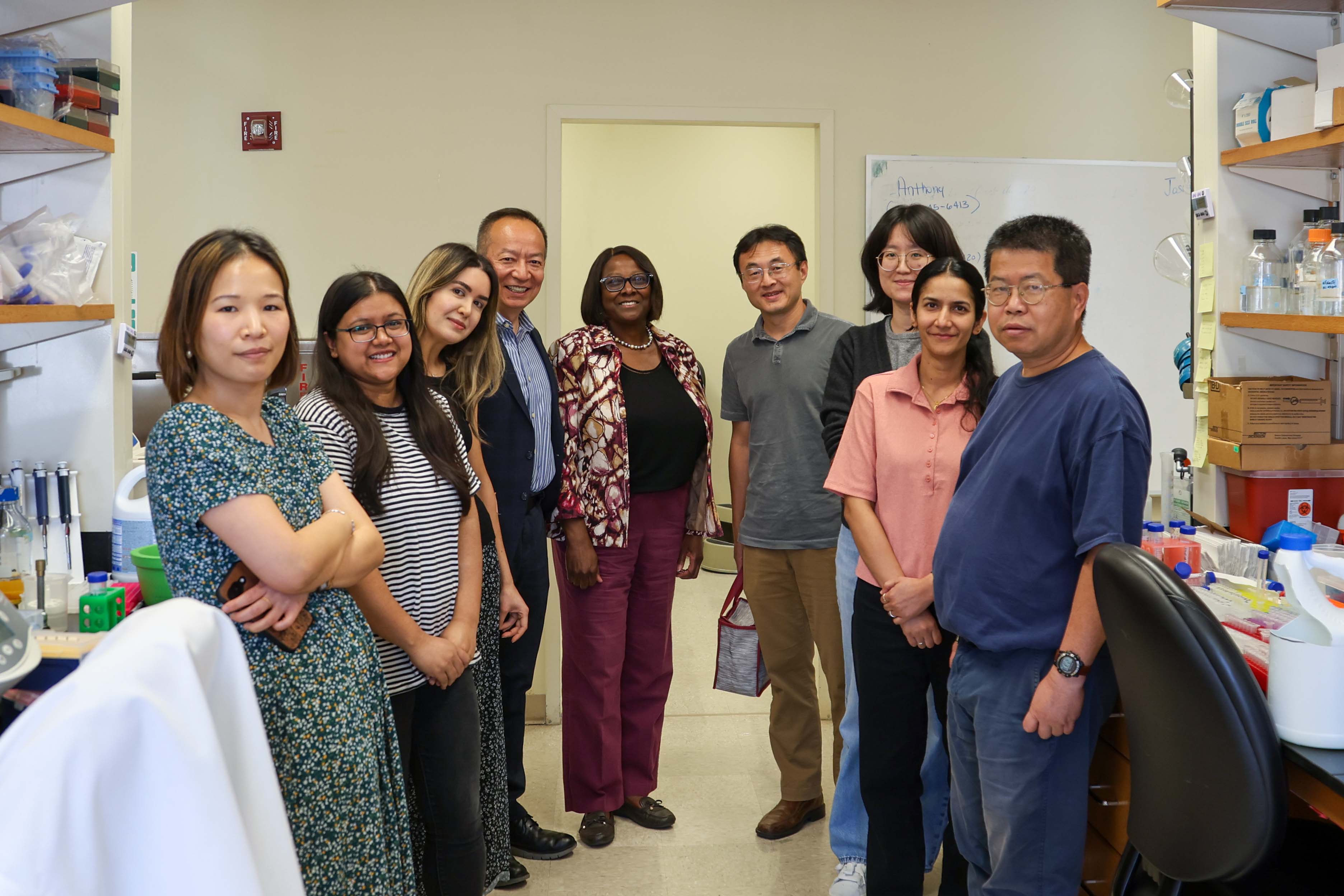
Yeling Hao, Hyeje Sumajit, Pilar Toledo, M.D., Julia Wang, Ph.D., Carson Mickey, Xue Hu, M.S., Pamela Sandoval, and Jyoti KC, M.S. photographed in Wang Lab
Wang lab pictured, from left, Yeling Hao, Hyeje Sumajit (Irianto Lab), Pilar Toledo, M.D., Julia Wang, Ph.D., Carson Mickey, Xue Hu, M.S., Ryan Kiddle (Irianto Lab), Pamela Sandoval Sanchez, M.S., and Jyoti KC, M.S.

For Wang, this award represents more than an opportunity to continue her research; it’s a personal and a professional win. Her longstanding interest in molecular genetics of human disease has prepared her for this milestone. 

“During my Ph.D., I joined a lab that applied molecular and genetic tools to diabetes research, and that experience really shaped my path,” said Wang, a researcher in the Department of Biomedical Sciences at Florida State University’s College of Medicine. “The more I learned, the more I didn’t know about diabetes; it is such a complex disease, involving genetics and environments.” 

Type 2 diabetes affects approximately 38 million American adults, according to the Centers for Disease Control and Prevention.


Now, Wang gets to really dive into the research with her own scientific questions and a $2.7 million R01— a prestigious Research Project Grant — from the NIDDK, an institute within the National Institutes of Health, or NIH. The R01 grant is the flagship funding award from the NIH that provides financial support to high impact projects for 4-5 years. 


NIH awards these highly competitive research grants to only a small percentage of applicants whose research will address a critical problem to progress disease treatment or therapeutic strategies. Wang’s research does just that.

Using human-derived pancreatic beta cells, the Wang lab examines the effects of metabolic stress on insulin secretion. Pancreatic beta cells sense glucose in the blood and secrete insulin proportional to blood glucose levels. 

Too much glucose and lipid over time creates cellular mayhem – more scientifically called glucotoxicity – which induces metabolic stress. 

Under metabolic stress, beta cells shift into overdrive to compensate for reduced insulin secretion. They begin to work harder, physically growing larger in size and number to produce more insulin. The increased workload ultimately leads to cellular exhaustion and eventual cell death.

“Beta cells are somewhat like a balloon under pressure. They can stretch and adapt as demand increases, but if the pressure keeps rising, they eventually reach a breaking point,” Wang said. 

Pilar Toledo, M.D. pipetting at the bench Wang's Lab in FSU Biomedical Sciences.

“Beta cells try to adjust and adapt, but with continuous exposure to high glucose and high lipid levels, they switch from adaptive to maladaptive. And they actually carry memory, too.”

Beta cell “memory” allows the cells to adapt and remain functional during temporary glucose spikes. However, consistently high blood glucose and high lipid levels overwork these cells as they remain in the adaptive state. Over time, beta cells can no longer keep up with demand, and they shift into a maladaptive, or dysfunctional, state. 

The overnutrition cell culture model the Wang lab uses mimics what pancreatic beta cells in our bodies might experience when exposed to chronic high fat, high sugar intake. 

With funding from NIDDK, the Wang lab will use genome editing and bioinformatic technologies to determine how beta cell stress contributes to Type 2 diabetes progression.

“We think the key memory marker is actually epigenetics,” Wang said. “We found a specific epigenetic modification that seems to really follow along the switch from beta cell adaptation to maladaptation.” 

Epigenetic modifications change how DNA is packaged, causing DNA to condense, making the cell’s instruction manual inaccessible to promote cell survival. In Type 2 diabetes, though, the instructions needed to sense glucose and secrete insulin aren’t readable, and beta cells overwork until they lose their function.

Wang’s lab has already identified several regulatory epigenetic processes involved in the switch from adaptive to maladaptive states, and Wang aims to use her recent grant award to fund molecular and genetic approaches to unravel these epigenetic modifications.

“This grant is taking advantage of all the technology development for the past decade,” she said. “With gene editing technology, we can open and close one regulatory region and basically make this region more active or make this region more repressive to see if it is really involved in the process.” 

Wang hopes these findings can be used to diagnose and even treat Type 2 diabetes.


Photos by Eduardo Miyar for the FSU College of Medicine.

Fluorescent microscope image of human-derived pancreatic beta cell

Human islet confocal image provided by Wang Lab

News of the Week

Kraft family endows professorship to honor loved one

By Patrick Crowley

FSU College of Medicine


The young boy who rode dirt bikes and loved everything mechanical brought a lot of joy to his family, particularly to his parents, Chris and Kellie Kraft of Tallahassee. 


“Oh, he scared me half to death racing those dirt bikes,” Kellie said, with a look of motherly concern. 


That little boy, Chris Kraft Jr., grew up tall (over six-foot!), enjoying life and everything he loved — especially cars and FSU sports. But he also grew up with something else — generalized epilepsy — the hardest to treat. And on Feb. 12, 2022, it took his life at age 36.


“When he passed away, I didn’t know how to process it,” said his brother, Chase Kraft. “We were so close. We practically did everything together. We played on ball teams together, carpooled together; we even sat next to each other on the school bus. It was a unique experience, and I was blessed to have that.” 

Posed with a giant check for $250,000 are, from left, Dean Alma Littles, M.D., Chris and Chase Kraft, Sanjay Kumar, Bill Gilbert and Kellie Kraft.

That bond between two brothers prompted Chase to establish the JR Foundation in honor of Chris Jr. shortly after his passing. 


“I found that doing the eulogy and speaking about him after he passed, I realized how much fulfillment he brought to my life, and that brought closure, peace and acceptance,” Chase said, adding that it motivated him to volunteer with organizations such as the Epilepsy Alliance of Florida, with which the Kraft family held fundraising events. 


“I found joy in that,” Chase said. 


Soon, an annual golf outing Chase and Chris Jr. took with their friends grew in attendance after Chris’ death and turned into a fundraiser with the goal of helping others with epilepsy. 


“We are celebrating the life of Chris Jr. We were raising a little bit of money, and I guess that kind of gave me the itch to jump in and do something more serious, more full-time, if you will,” said Chase, a successful entrepreneur with a variety of business ventures in New Orleans. “That’s how the JR Foundation came to be.”


With that same philanthropic bent and desire to help others with epilepsy and their families, Chris Sr., and wife Kellie were already involved with non-profit organizations, including the Epilepsy Agency of the Big Bend and the Epilepsy Alliance of Florida, where they underwrote the cost of seizure dogs for people with epilepsy. The Krafts were also holding fundraising events of their own, such as a Singer-Songwriter Festival at the Governor’s Club in Tallahassee, followed by a concert with one of Chris Jr.’s favorite bands, Molly Hatchet, at FSU’s Dunlap Champions Club. 


“We brought Molly Hatchet in for Chirs Jr.’s 40th birthday,” Chris Sr. said. “We had over 450 people there. We filled up the ballroom.” 


When Chase came to Chris and Kellie with the idea of starting their own foundation, they were more than willing to help, as were Chris Jr.’s other siblings, Katie and Cody. 


According to Kellie, “Our four children were very close and Chris Jr.’s loss was devastating.” Kellie added that managing Chris Jr.’s epilepsy was a family effort, as everyone knew the signs of a pending seizure and how to handle one if it did occur. “As Chris got older, he could fake it with most people, but he couldn’t fake it with us. Mom knows!”
 

“The week we lost Chris Jr. — I think it was day three — Chase said, ‘We have to do something,’” Chris said. “He would call me from New Orleans and just say, ‘Dad, we can do this. We can take the pain and do something.’”


And do something they did. In January, the JR Foundation made its biggest, single gift: $250,000 to the FSU College of Medicine to endow a professorship in the lab of Sanjay Kumar, Ph.D., to further his epilepsy research. Kumar is now the proud holder of the JR Foundation Endowed Professorship in Epilepsy Research. 


“I am truly grateful to the JR Foundation and the Kraft family for their generosity in funding research from my laboratory; for their confidence in my abilities to undertake this research, and for selecting me for the endowed professorship in Chris Jr.’s name and honor,” Kumar said. 


It was by happenstance that the Kraft family and Bill Gilbert, treasurer of the JR Foundation, learned that epilepsy research was being conducted just a few miles from their Tallahassee home. They learned about it while talking to a friend at a golf outing who was familiar with the work being done at the College of Medicine. 


“I went out and started googling epilepsy research and what organizations help with it,” Gilbert said. “I put in some key words online, ‘Tallahassee, Florida, FSU, State of Florida, South Georgia,’ etc., and that is how I came about Dr. Kumar's page. I had no idea he was doing that kind of research here in Tallahassee, and as soon as I found it, I started reading, researching, and then had to let the family know.  The Krafts, even Chris Jr, are huge FSU fans, as you can imagine, so I knew it was lining up with multiple boxes we were looking to check, to be able to help out and possibly find a cure.”


Finding a cure and effective treatment for epilepsy is front and center for Kumar. 


“The ultimate goal of my research is to find a cure for temporal lobe epilepsy which has eluded us for so long,” Kumar said. “TLE is the most common form of adult epilepsies that has proven intractable to anti-epileptic medications. The realization that TLE can be a neurodegenerative disorder in addition to being a hyperexcitability/hypersynchrony disorder, which has come about from basic research in my laboratory, has allowed us to pursue this disease from novel therapeutic perspectives, bringing us closer to that goal.”


Without question, the gift from the JR Foundation is deeply personal for the Kraft family. If you would like to lend your support by making a charitable gift to the endowed professorship, visit give.fsu.edu/JRprofessorship


Chris and Kellie Kraft hold a poster with a photo of their son

Chris and Kellie Kraft hold a poster announcing “A Night to Remember” fundraising event for epilepsy, featuring a picture of Chris Jr. 

Introducing Library News

May 15, 2026
""

We are excited to announce that we now have the ability to share Library News! Watch this space for updates from your Maguire Medical Library! 

(Note: "this space" refers to a particular section of the medical library's homepage)