

Speights' final lecture sends M.D. Class of '26 into the future
By Bob Thomas
FSU College of Medicine
Bracketed by the musical works of Sir Edward Elgar’s “Pomp and Circumstance” and John Stanley's "Voluntary," the 121-member Florida State University College of Medicine M.D. Class of 2026 marched into Ruby Diamond Concert Hall Saturday as students and marched out as doctors.
Joining them in the recessional line were seven newly-minted Master of Science in Biomedical Sciences – Bridge to Clinical Medicine graduates, who in 10 days will begin their own march to becoming doctors as members of the M.D. Class of 2030.
The ceremonial observance of commencement – where the processional is followed by an invocation, conferring of degrees, hooding, recitation of the physician’s oath and the recessional – remained very much the same as the College of Medicine graduated its 22nd class.
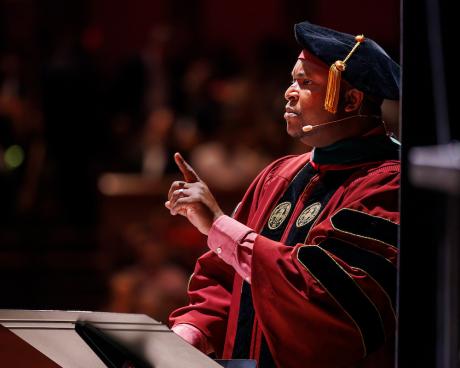
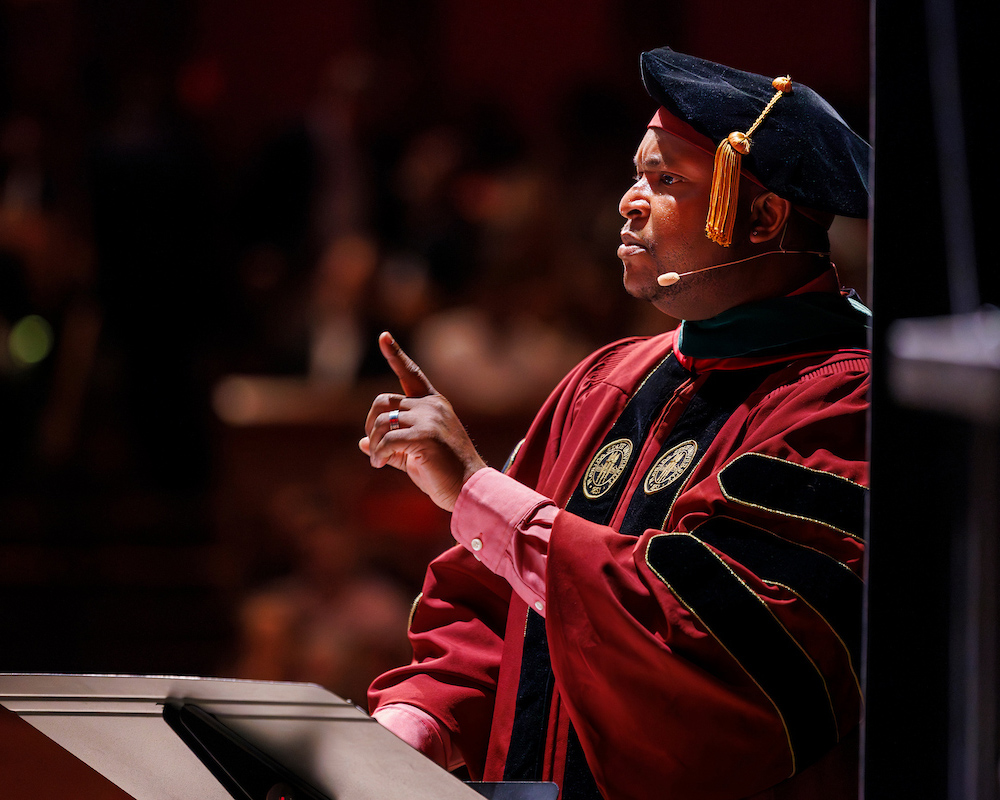
But Dr. Anthony Speights, senior associate dean for medical education and academic affairs, broke from tradition as he donned a wireless microphone and delivered the commencement address facing the class.
“On to the life lesson of the day. Your last, and hopefully best, lesson from me,” Speights said, his back to the audience and eyes locked on the students before him on stage.
Speights’ address ranged widely from playful to poignant; focused on his observations of how students had changed since he and his Generation X peers “believe we were just built different” than the students he addressed.
For illustration, he referred to his generation as latchkey kids, the MTV generation that never used seatbelts and the first generation with cell phones; as residents who worked 100-hour weeks without time restrictions, slept in the hospital call room and, in many instances, became physicians who were absent from home, grumpy, placed patients and career before everything, and burned out.
“Now that I’ve spent so much time over the years telling you how different your generation is than mine as if it’s a bad thing, let me tell you why your generation is different than mine, in all the ways I admire. …
“You’ve learned to support each other in ways our generation never did. … You’ve come to understand the need for balance in work and life.
“You’ve heard me say many times, often in what sounded like a critical way, that your generation doesn’t want to work as hard as the ones before you. But in all honesty, after all these years I can let you in on a little secret. That wasn’t criticism. It was jealousy.”
Speights praised the class – and its generation – for how it has found ways to be efficient and work hard, but find time to “smell the roses, watch some Netflix and hang out.” How it had taught his generation of physicians the importance of mental self-care.
And he reminded the class of a message delivered to them by the late Dr. Daniel Van Durme on their first day as medical students.
”Dan said something like this: Each of us is filled with a reservoir of compassion and caring. It’s like a river, flowing from you to your patients. Guard against becoming jaded, because it will dam that river up, but also keep in mind that if your reservoir is constantly flowing, it has to be refilled, or it will run dry.
“Find and do things that refill that reservoir of compassion and caring. Caring is integral. Patients don’t care how much you know, until they know how much you care.”
There is no shortage of physicians from the class who heeded that advice; many of whom were honored on the eve of commencement at the Class of 2026 Presentation of Awards ceremony.
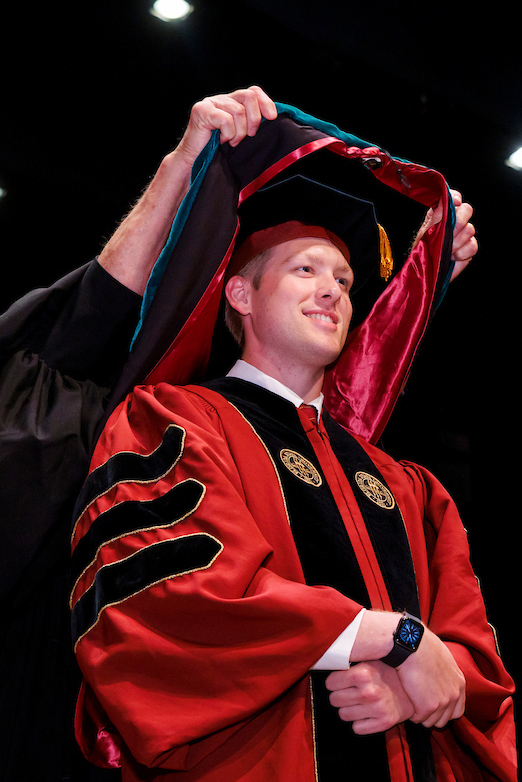 Ben Linkous, who completed his final two years at the Pensacola Regional Campus near his hometown of Gulf Breeze, received the Mission Award. Linkous is headed to Newark, Delaware for a general surgery residency; a departure from the family medicine route he initially envisioned for himself. His third-year rotation through the Marianna Rural Program, at the 100-bed Jackson Hospital, changed his trajectory, thanks to the influence of doctors Vechai Arunakul and John Brunner.
“I fell in love with rural healthcare and what the general surgeon can do in those types of communities,” Linkous said. “[Arunakal and Brunner] were huge role models for me, being able to see how they impacted the community. …. Eventually, the plan is to come back to the Panhandle and be the rural general surgeon in a community along I-10.
“It’s everything you want in a profession. Getting to experience humanism in your day-to-day job, it gave me the breadth of working with anyone from kids to the geriatric population, working in emergency situations and more relaxed settings. Being a rural surgeon was just hitting all of the marks for me; being able to be that strong community figure, have a wide-scope practice and come in every day and just be like, ‘Man, I love where I’m at.’”
Befitting of her strong faith, Katelyn Cornelius was selected to deliver the invocation Saturday.
“My faith has always been a big part of my life,” said Cornelius, who completed her clinical education at the Orlando Regional Campus, near her hometown of Winter Park. “Before I started medical school, I got to work at a clinic for patients without insurance that's faith-based in Orlando. I really saw how these people's desire to serve was so driven by their faith. And I worked with a pediatrician who used to talk about how, you know, we're called to be loving in anything that we do.
“So from the start of medical school, I kind of thought a lot about that as a focus and how can I be loving and joyful in all the things that I do.”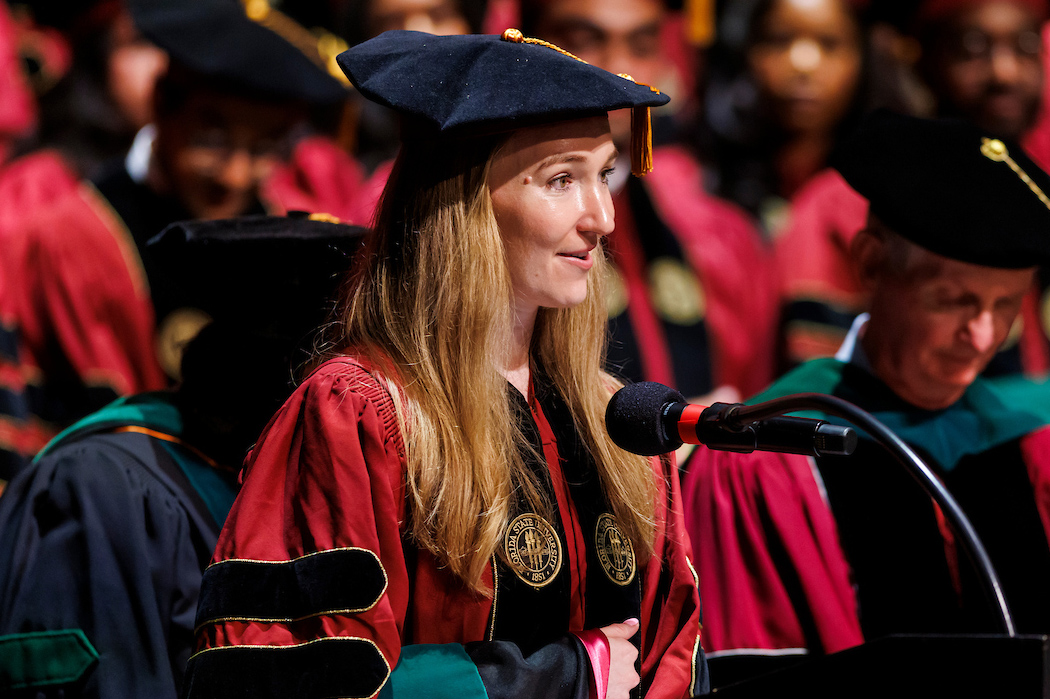
Cornelius carried that mindset throughout her time at the College of Medicine and others noticed. At Friday's awards ceremony, the Alpha Omega Alpha and Gold Humanism Honor Society inductee was recognized as the Orlando Regional Campus Dean’s Award winner. She also was one of eight American Medical Women’s Association’s Glasgow-Rubin Citation recipients for ranking in the top 10% of her class and demonstrating leadership, service and advocacy.
Dr. Alma Littles, dean of the College of Medicine, presented Cornelius the J. Ocie Harris Outstanding Student Award – the final award of the afternoon – which recognizes the student who has shown the best all-around promise of becoming a physician of the highest caliber.
“People ask me, ‘Why are you like this? Why are you so nice and kind and focused? Why do you know this information?'” she explained. “For me, it is loving and caring, and that feels like my mission and my ministry to others; to learn this information well, to care for people well, to help them feel seen and heard and loved at the end of the day.”
Bridge graduate Shaun Franklin, who has already earned praise from faculty for his compassionate clinical care skills, was locked in throughout Speights’ commencement address.
“I'm excited about today, but more excited to get started with the M.D. class,” said Franklin, who will join his Bridge classmates back on campus to begin their four-year journey May 26. “[Bridge] was a great experience. We're all pretty close; we just have each other. We're a tight-knit family here and I think that made a difference.”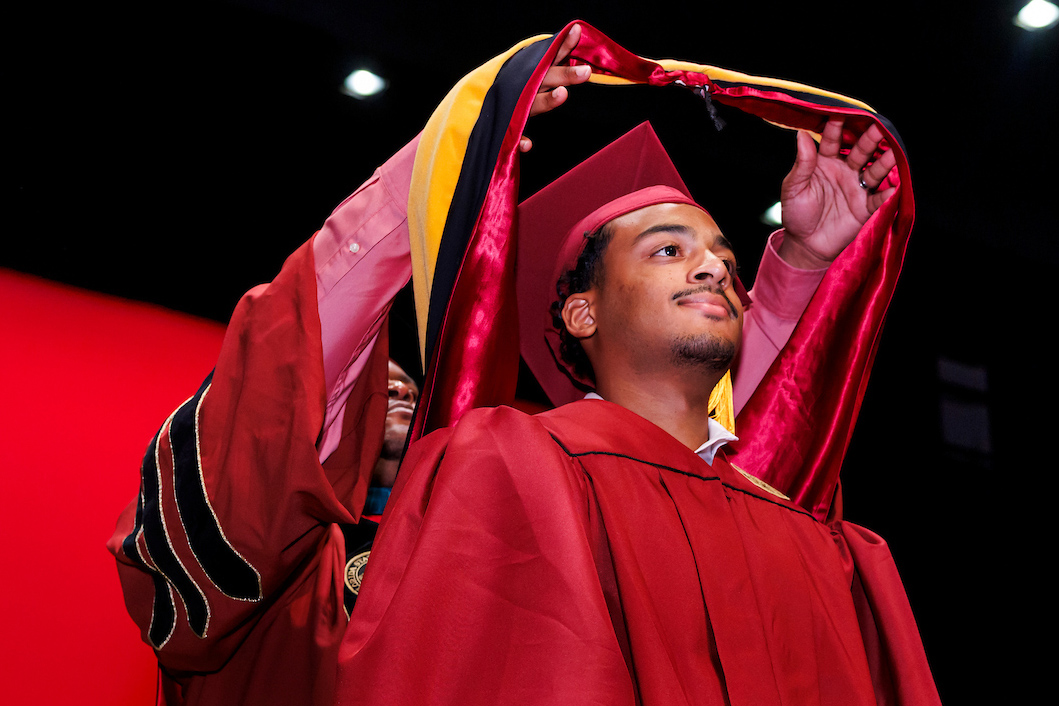
Photo captions from top:
Dr. Anthony Speights, senior associate dean for medical education and academic affairs, delivers his commencement address to the M.D. Class of 2026.
Graduate Ben Linkous plans to return to the Florida Panhandle as a rural general surgeon following residency in Delaware.
Katelyn Cornelius, who will complete her residency in dermatology, delivered the invocation. Cornelius received the J. Ocie Harris Outstanding Student Award on Friday.
Shaun Franklin received his Master of Science in Biomedical Sciences - Bridge to Clinical Medicine degree and will be joining the M.D. Class of 2030 on May 26.
Photos by Colin Hackley for the FSU College of Medicine